
In these times of extreme polarization, leaders must prioritize the development of the skill of engaging in difficult conversations and mastering the art of respectful disagreement. There is a pivotal role these abilities play in fostering effective communication, nurturing healthy relationships, and driving organizational growth. Difficult conversations, whether addressing employee performance issues or navigating conflicting viewpoints among advisors, are inevitable in any leadership role and demand a willingness to navigate them constructively. By honing the ability to respectfully disagree, leaders create an environment where diverse perspectives are valued, leading to richer discussions, enhanced problem-solving, and ultimately, more informed decision-making. Plus, mastering these skills cultivates trust, strengthens team dynamics, and empowers individuals to voice their opinions confidently, fostering a culture of openness and innovation within the organization.
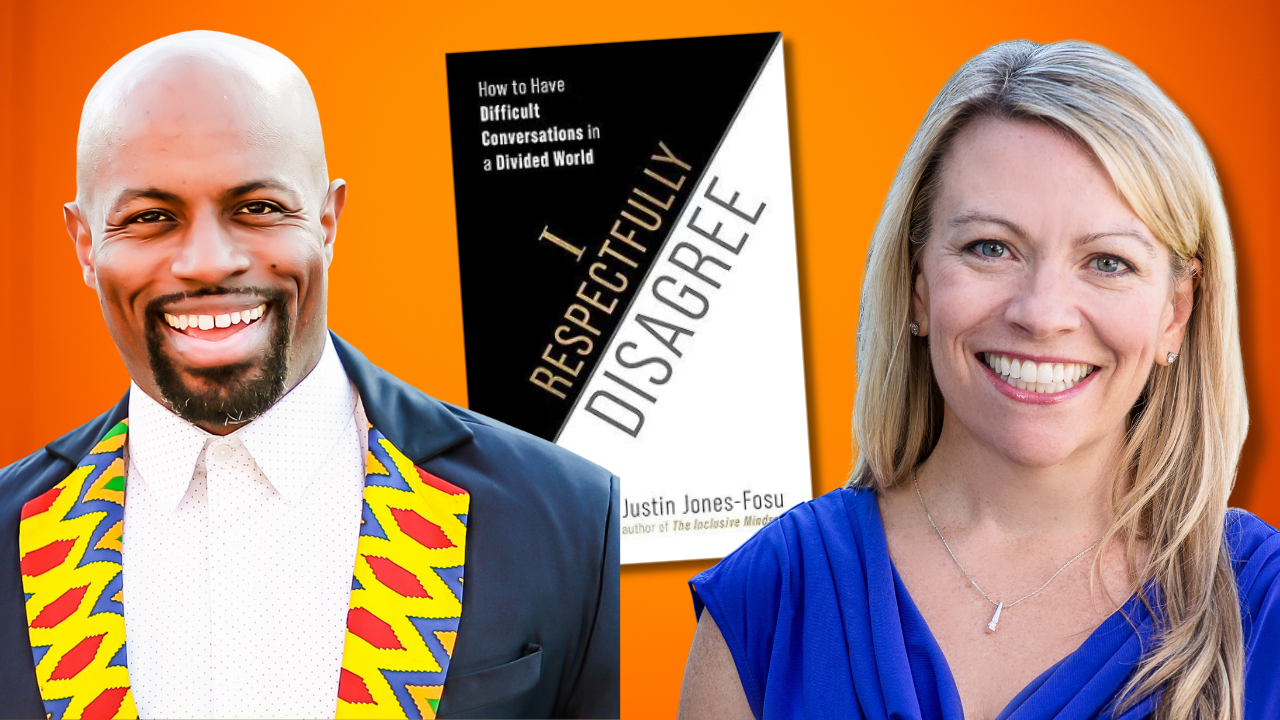
In this episode, our guest is Justin Jones-Fosu, MBA, CSP, the CEO of Work.Meaningful. Justin brings over two decades of expertise in employee experience and inclusion. His book, “I Respectfully Disagree,” offers a refreshing take on conflict management, emphasizing the significance of genuine respect and understanding in difficult conversations. Through his unique framework, Justin encourages individuals and organizations to challenge perspectives, cultivate curiosity, and seek common ground. With a passion for creating respectful environments, Justin’s work has significantly impacted leaders and teams, fostering healthier and more productive discussions. His approach not only provides practical tools but also delves into the heart of respectful disagreement, making his insights invaluable for those seeking to enhance their conflict-resolution skills.
Justin states that his book is “certainly not making the claim that respect alone can solve the world’s biggest problems. But respect on an interpersonal level, in our day-to-day lives, can plant seeds of change in the hearts of those we encounter.”
Get I Respectfully Disagree on Amazon: https://a.co/d/icyhJLp
In this episode, you will be able to:
- understand conflict management and how to give feedback to foster a positive work environment.
- prioritize compassionate thinking for a happier, more productive team.
- take a strategic approach to constructive dialogue for professional success.
- learn how to stay connected to people and enhance teamwork and communication.
View Transcript
Transcript — How I Turned the Corner, hosted by Kendra Prospero
Kendra: As you all know, I’ve worked with lots of people over the years, and one thing that most leaders struggle with consistently is conflict and giving feedback. Most people just don’t know how to do it, and they don’t know what to do when there’s push back and an argument starts. Well, our guest today has a great formula for how we can have more respectful, dignified conversations that are also difficult. Justin Jones-Fosu is the CEO of Work Meaningful and the author of the book I Respectfully Disagree, and he’s outlined a really unique and neat process for managing conflict and figuring out how to have conversations that are more effective. Justin, welcome to How I Turned the Corner.
Justin: Thank you so much, I’m grateful to turn the corner with you.
Kendra: That’s great. So, I know you and I have a long history together — we’ve known each other for about five years now, and I’ve loved watching your journey. We’ll get a little more into the work you do with Work Meaningful, but I want to know: what prompted you to write this book? Can you tell the backstory?
Justin: Yeah, so I’ve been doing a lot of work around this intersection of employee experience and inclusion — now close to a little over 20 years — and really just understanding it. When we did work around the inclusive mindset, there was a statement I would make in one of our modules and presentations: that I believe we can vehemently disagree with someone’s ideology and yet passionately pursue their humanity. It always resonated with the audience — people would say, “Oh, there’s something there.” But oftentimes when people came up to me afterward and said, “We love that,” I’d ask, “What specifically was meaningful about it?” And they’d bring that up, but they’d also say, “I just struggle with how to do it. I want to do it right.” I heard that over and over again for the last five years, and a little bit longer.
I decided to really lean in, because I was actually getting sick and tired of hearing a lot of disrespectful banter back and forth around a myriad of different issues — not just societal things, but just life. I also looked in the mirror and thought, Justin, you at times are disrespectfully disagreeing with others too. So I wanted to do something first for myself, and then figure out how I could help others.
So the three things that became my “whys”: One, I wanted to create a better environment for my kids coming up into this world — one that’s just a little more respectful, because some of the stuff I see adults doing, my kids would be disciplined for. That’s number one. Number two, I wanted to help answer the question of how to do it. And number three — and this is going to sound counter to number two, but it’s related — I saw that there were a lot of books, once I really started digging into this, on the mechanics of disagreeing and navigating conflict, but they never got to the heart of it. They didn’t get to why we should want to. I even had a conversation with someone today — she said, “Yes, yes, that’s really good,” because “what people say matters.” And I said, no, it’s not just what people say, it’s what people think, because I know a lot of people who are disrespectfully disagreeing with others internally, even if externally it comes off as “hey, I’m with you.” So we wanted to really address the heart of the issue, and that’s what inspired me to write the book. And I didn’t plan for it to come out at this particular time, but I feel like now, more than ever, it’s going to be needed — not only because of what’s going on globally with wars and everything happening, but also because of what’s coming within U.S. society.
Kendra: Yeah, my own backstory on some of this is that I didn’t grow up in a family that necessarily dealt with conflict well, so I love your first goal of teaching your kids — because I didn’t learn how to lean into conflict, really speak my mind, share when I didn’t agree. I didn’t know how to do that. So when I became an adult, I ended up marrying someone who demands that I do this well, and I get to practice having dignified conversations every day, because he’s very good at it. My husband is very good at it, and he doesn’t let any conflict slip through. The result has been a really healthy relationship, built on a lot of trust, that feels safe and vulnerable — and when there’s safety, there are neat things we get to do together. I feel like this topic is so critical, because when you can’t respectfully disagree and navigate conflict, it shuts down everything in the long run — in our businesses and in society.
Justin: 100%. You said something key, because we didn’t initially set out to study this piece specifically, but in our research we found it, and we created a matrix to talk about respect and disagreement. We initially just wanted to help people turn disrespectful disagreement into respectful disagreement, but when we dug deeper, we found people like you — people who don’t really struggle with that part — and a whole other category we call disrespectful agreement. What we found is that in workplaces where leaders aren’t addressing this, people are externally agreeing, or choosing not to say anything, even when they have an opposing perspective — because they haven’t learned how to use their voice, or they don’t feel empowered to. So disrespectful agreement is where people are either disrespecting others by agreeing in the meeting and then disagreeing behind their back, or disrespecting themselves by not bringing their voice forward — which blocks the innovation you were just talking about. I think you’re spot on, and that’s another area of the book we aim to address.
Kendra: So talk a little about what you teach in the book. You sent it to me — it’s being released soon, right? So I got a pre-copy, which I appreciated. Share the process with our listeners — you’ll do a better job of it than I will.
Justin: Sure. We really take it through three phases. The first is how we approach it — the heart behind it. While there are some “how-tos,” the foundation is the why. This isn’t just “take some deep breaths” or “do these five things,” because people know when something’s genuine, and that’s something a lot of leadership training misses — we teach the mechanics but not the heart behind it. So I start by welcoming people to understand their own journey. One of our big chapters is on how we learn from our past, and how that shapes whether or how we disagree with others, because it impacts us. I broke down my own journey of understanding that I wasn’t going to be that abused little kid anymore — I was very disrespectful and very aggressive in my disagreements, because I was playing out things that happened to me as a kid. So that’s the heart of it.
The second piece we dive into is that when we talk about respectful disagreement, we first have to identify what respect actually is. I feel like there are a lot of misperceptions — people say respect has to be earned, and my retort is: why? Why can’t we, like forgiveness, choose to freely give it to someone else? Respect isn’t about position or title, and I’ve learned that a lot from being a parent — I’ve oftentimes disrespectfully disagreed with my kids and had to go back and apologize, because I rested on the position of “of course I know best,” when I often didn’t.
The last part is our five-pillars framework — five things we found essential to respectful disagreement. First is to challenge your perspective — the pre-work before you even get into disagreements, around how you hear other people’s voices and what you’re learning about them. The second is to be the student in every situation — operating from a place of “there’s something for me to learn.” The third is to cultivate your curiosity — when you cultivate curiosity, you’re listening differently, asking more questions, and as Stephen Covey talked about, seeking first to understand, then to be understood. The fourth pillar is seeking the gray — one of my favorite concepts. I often go into disagreements asking, “What can we create together?” because we often see things in black and white, but there’s a gray area that lets us find commonality and common ground. There’s actually research showing that when I’m intentional about finding the gray, people hear my perspective even more. And the last is to agree to respect — we always have the choice to respectfully engage with someone else, even if I vehemently disagree with what they say. I can always acknowledge them, always say, “Thank you, I’ve never heard that perspective before.” I don’t have to go to “I can’t believe you thought that” or “that was stupid.” Those are the five pillars, and we walk through action-based steps for each one — that’s the basis of how we approach the work.
Kendra: I love it, that’s great. For everyone listening — I recommend you pick it up, and we’ll link it in the show notes — there’s also a really useful four-quadrant model for thinking about disagreeing, and even agreeing. It’s just a great visual, so we’ll include that too. But I highly recommend grabbing the book if you struggle with conflict, or you get polarized, or you feel polarization in a conversation — it’s a great way to get more tools for working on that.
So I want to move a little away from the book specifically and talk about the business you run, because there are some really neat things you’re doing there too. Can you tell us about Work Meaningful?
Justin: Sure — Work Meaningful is a learning and development company centered on the intersection of employee experience and inclusion, whether that’s in-person presentations, consulting, training, or e-learning. We partner with organizations to do that work, and what I love is the team I get to do it with — that’s the real joy. We have both U.S.-based and Ghana-based team members — I’m a dual citizen of Ghana and the United States — so we have team members on two continents, which brings me great joy.
The essence of what we do is help people realize, individually, that it’s not about finding meaning in their work, it’s about bringing meaning to their work. We leverage the original job-crafting research (citation heard as “Barowski and Sutton, 2001” — likely Wrzesniewski and Dutton’s 2001 job-crafting research; please verify the exact citation before publishing) to create a framework for people to bring meaning to their work. The second tier is leaders — part of leadership is recognizing that no single leader causes employee engagement. What we do is create the best environment where people can engage themselves, because I know some of the top engagement companies, and guess what — they still have disengaged people, because engagement is a choice. As leaders, we make that choice easier or harder, but that’s what we do: we help organizations create better cultures, better engage their employees, and ultimately challenge every associate and team member to choose to bring meaning themselves, because that’s the only thing we can actually control.
Kendra: It’s great, because I think when we met, we commiserated on this — we both eat our own cooking and practice this in our own businesses. I see Turning the Corner as kind of a petri dish for trying out what works and what doesn’t, and I figure if we can make it work in our little business, we can teach it to companies. And if we try something and it flops, we examine why and ask whether it’s just not a good idea. One of the things you’re experimenting with, and have already implemented, is the four-day work week. Can you talk about what you’ve done there?
Justin: Sure. In the employee experience space I’d heard about companies exploring this, and I thought it might be a fad. But as I dug into the research, I saw that in four days, a lot of companies were seeing similar productivity to those working five. Our first shift actually began a little before last year — we tried it out, doing four days but still roughly the general 40 hours, some people salaried, some hourly. Then I kept researching and realized companies were putting in long, 10-hour days to cram 40 hours into four days. So I dug deeper and we landed on 32 hours over four days — differs a bit for salary versus hourly — but still getting the same pay. We didn’t cut pay; we kept it at the same amount for 32 hours as they’d been getting for 40. The real impetus for us was that I’m really passionate about self-care — what we actually call “self-best,” because people often struggle with self-care since it feels selfish, but when you’re self-best, you can be better for others. So I thought, what if we designated Fridays for self-care? We leaned into that — “we’ve given you this time, this space, to do self-care” — and that’s where we landed.
Our team, here and in Ghana — and in Ghana that’s unheard of, that people have a four-day week and get paid the same as 40 hours while working 32 — my team members brag about it. Two of them are doing their MBAs right now, and their classmates don’t believe them about their work setup. But it comes from our first family value, which is to treat our team like family — I ask myself, how would I want my own family members treated? That’s how we moved from a 40-hour four-day week to a 32-hour four-day week, with Friday explicitly for self-care. Our team loves it, we’ve kept the same productivity we had before, and our team is energized and excited to come to work. Not every day is perfect, but I’ve seen real appreciation from them for what we implemented.
Kendra: I’ve personally experienced something similar. I had a part-time job right after I had my daughter — many years ago now — and I could only get child care for 17 hours a week. I found a nanny I loved, but she only had 17 hours to give me. I went back to my boss and said I could work 17 hours — this was before everyone had a laptop, back in the 2000s — and I had this very constrained schedule. Justin, I showed up and I worked, because I knew I only had 17 hours to get it done. I barely took bathroom breaks. There was no water-cooler talk, no meetings I didn’t think would push my agenda forward. I easily did 40 or 50 hours’ worth of work in that 17 hours, and it was so eye-opening around how a constrained schedule, when you compress time down, changes how much you can get done. There’s such a debate right now around bringing people back to the office and flexibility, and I’m always on this soapbox that this stuff really works — I’ve experienced it personally, and I see it on my team too. Some are part-time, some work a 32-hour week, some have energy for more — I don’t micromanage any of it, I just let people show up and do what they have energy for, and I think it works great.
Justin: Yeah, and I appreciate that you experimented with both the four 10-hour days and now the 32-hour week, because I agree — when I do four 10s, I’m exhausted, that’s a long day. You reminded me — that’s why you’re brilliant, Kendra. Do you remember the movie The Pursuit of Happyness? Remember when he was constrained by time, and had to rush to get to the shelter, so he found his hack of not putting down the phone while all the other candidates did? That’s what you reminded me of — we find those things when we hold ourselves to the same expectations and responsibilities, we just don’t decrease them.
Kendra: Right, so what’s beautiful is that the team found a way, the same way you found a way — your team found a way to get the work done, meet the responsibilities, and lean in where it matters. I think that’s been valuable. One of the things I love that we’ve leaned into even more is our “care call.” I’m really big on focus, and one of the things we share with leaders is that you give more to your people than you ask of them — oftentimes we don’t do that, we’re trying to get more out of people even without meaning to. So I try to challenge myself: how can I be intentional about that? We have a care call once a month, it’s paid, not on a Friday, for an hour to an hour and a half, and we just talk about how we’re doing — nothing business-related. If it starts drifting into business, I cut it off. We go through how you’re doing mentally, spiritually, physically, emotionally. We’ve actually created a self-care framework (heard as a “5 S.C. square” — please verify the exact name before publishing) where we walk through how you’re doing with daily, weekly, monthly, quarterly, and annual self-care, and what are some ways you could get better. Those calls have drawn us so close together, because we’re caring for each other, asking how we can show up for each other. Not every company or CEO can do a full care call with employees, but what if they did it just once? Having a designated time to ask “how are you doing” without it feeling transactional — that’s part of what it means to treat people like family. We don’t just come home and not ask how someone’s day was — well, some people don’t, but we challenge ourselves to. We’re not perfect at it, but I’m grateful for the progress we’ve made.
Kendra: No, I agree. We’re running a pretty unique hybrid environment now — we’re fully remote, we don’t have an office space anymore, though we do have an arrangement with a local co-working-style space. We come together every week on Thursdays for our team meeting; three out of four weeks it’s over Zoom, and once a month we come together face to face. When we do, I structure those meetings to be non-business — team building, skill building, learning about each other, having a meal together. It’s just fun. I kind of accidentally started doing this about a year and a half ago, and it’s worked out wonderfully. So when people worry about culture in a remote company, I say there are ways to do this — sometimes you stumble onto it, like it sounds like you stumbled onto the care calls, and then you realize it makes a big difference, instead of having a rigid rule about how something needs to be.
Justin: I’m seeing that more and more. I have a lot of friends in the corporate space, and I try to see the gray in all of this — I ask deeper questions, I really want to understand. But for those doing hybrid, where people go in but don’t feel like there’s any purpose to it, they’re not intentionally connecting with their team when they’re there — I think if companies are going to do this, there has to be much more strategy behind it. Is it a time for us to come together intentionally, to build together, to learn about each other, in a way that’s even more intentional than when we were fully in the office — because we might do that at a sales meeting or company kickoff or annual event, but we often weren’t intentional about it on a monthly basis, cultivating relationships and community within the organization. So kudos to you for doing that — I’ve seen a lot of organizations really struggling with it because they don’t have a strategy behind it.
Kendra: I totally agree. My husband’s company wants him in the office two days a week — whichever two days he chooses — so he’s shown up and there hasn’t been a single other person in the building. He says, “well, that’s a waste of a shower.”
Justin: I love that — that’s a good line, “a waste of a shower.” But it should be like we teach now — there are core hours and flexible hours. Your core hours should be the same for the most part, doesn’t have to be rigid, but keep your core in-office days consistent, and that’s when you’re doing things together in person. Otherwise the rest of the time can be flexible. We’re even calling it something other than “hybrid” now, because that word isn’t clear enough anymore. But you’re right, there needs to be strategy — when we come together, what are we doing? We’re intentional about the meetings that require face-to-face, and if we don’t need to be face to face, why not do it over Zoom or Teams?
Kendra: That’s excellent. So, with all the education and learning you’re doing — what’s your intention with the book, bringing it back through to Work Meaningful? Are you running workshops with it?
Justin: We’ve actually already been doing that. Even before the book, we beta-tested a lot of workshops specific to I Respectfully Disagree, since we were already teaching some of those principles as part of our inclusive-mindset modules. Now we’ve expanded with the book, and we’re getting ready to roll out full modules — we’re recording our next course on it, coming out in October — working through microlearning modules on how to actually implement this, because not everyone can attend a full presentation or training, or work through the consulting side of it. We do a lot of work with credit unions, for example, where frontline associates might only get two days, so we’ve built ways to help workplaces be more meaningful even in that constraint — respectfully disagreeing, honoring and valuing each other, providing dignity within teams.
I keep seeing two things rising to the top for leaders: one, how to navigate a workforce on polarizing issues — elections, DEI, and other topics people are divided on — and two, people are afraid to say things, afraid to speak up, afraid to share their honest perspective because they don’t want to get canceled. What ends up happening is we never get people’s full selves, just their representative, because people feel like they’re walking on eggshells, unsure what they can say or how to say it. I think that’s stifling innovation and creativity, and wasting energy that could go toward making our organizations better.
Kendra: I think the hard thing is it almost has to be collective — it has to be a movement.
Justin: 100%, and I wish that for you too, I want that. Little by little — our big focus, I don’t know if you can see behind me, but that’s a tortoise. It’s one of our family values — the tortoise principle. It’s one of my favorite fables growing up, the tortoise and the hare. We always called the tortoise slow — but the tortoise wasn’t slow, it was strategic. It’s only called slow because we compare it to the hare, and I’ve seen a lot of hares in our society. So we encourage organizations and individuals to take the tortoise approach — not slow, strategic — building on a foundation and consistently getting better, which has long-lasting sustainability. We’re not chasing the quick fix of “we’ll get through this election and suddenly everyone respects disagreement” — no, it’s about cultivating character in people, and as we grow over time, it crescendos into other people. So to your point, yes, a movement — but not a flash-in-the-pan movement that’s here today and gone tomorrow. We want to build on a solid foundation that really impacts people’s hearts, to better engage with each other, with greater dignity, value, and respect. That movement is the tortoise principle.
Kendra: Well, I think that’s a perfect place to end our talk today. So Justin, what’s the best way to get in touch with you?
Justin: WorkMeaningful.com is the best way to reach us. You can also connect with me on LinkedIn — Justin Jones-Fosu — and if you see me dancing in a video, just say hey.
Kendra: Absolutely, we’ll put all that information in the show notes as well. Well, thank you so much for joining me today on How I Turned the Corner.
Justin: Absolutely, Kendra — you’re awesome, great job.