
Crossing 50 employees is a milestone worth celebrating. It is also often the point when the people practices that helped a company grow start showing their limits.
The CEO can no longer personally know everything happening across the organization. Managers are making more employment decisions. Policies written years ago may no longer reflect how the company operates. Benefits are more complex. Performance problems become harder to solve informally. And certain employment laws may apply differently as your workforce grows.
This does not mean you need to build a huge HR department overnight.
It does mean you need to become more intentional about how your company manages people.
At Turning the Corner HR, we often see companies reach this stage after years of successful growth. The challenge is rarely that they have done something terribly wrong. More often, the systems that worked for 15 or 25 people simply were not designed for 50, 75, or 100.
Here is what we recommend CEOs prioritize during the first 90 days after reaching this stage of growth.
First, Understand What Actually Changes at 50 Employees
There is a common misconception that reaching 50 employees causes a giant switch to flip and suddenly subjects a company to an entirely new set of employment laws.
It is more complicated than that.
Some federal employment laws begin applying well before a company reaches 50 employees. Others use different definitions, measurement periods, locations, or employee counting methods.
For example, the Family and Medical Leave Act generally covers private employers with 50 or more employees, while individual employee eligibility also depends on factors including length of employment, hours worked, and whether the employer has at least 50 employees within 75 miles of the employee’s worksite.
The Affordable Care Act uses another calculation. An employer is generally considered an Applicable Large Employer for a calendar year if it averaged at least 50 full time employees, including full time equivalent employees, during the previous calendar year.
This is why “we have 50 people now” is not enough information to determine every compliance obligation.
Your first step should be a proper HR compliance review based on your actual workforce, locations, benefits, structure, and employee classifications.
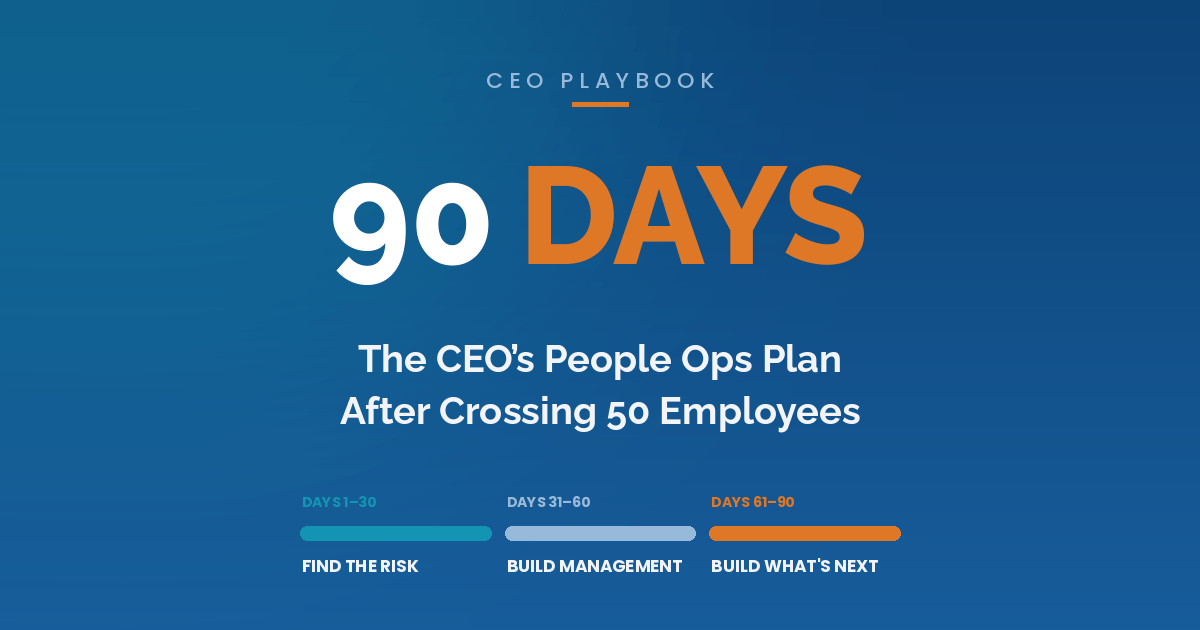
Days 1 Through 30: Find the Risk Before You Build More Process
The first 30 days should be about visibility.
Before adding new HR programs, understand what already exists, what is working, and where the company has exposure.
1. Complete an HR compliance audit
Review the fundamentals, including:
- Employee classifications
- Exempt and nonexempt status
- Personnel records
- Form I 9 records
- Required workplace notices
- Leave policies
- Benefits administration responsibilities
- Hiring practices
- Termination procedures
- Wage and hour practices
- State and local employment requirements
If employees work in multiple states, this review becomes especially important. Employment requirements are often based on where the employee performs the work, not simply where company headquarters are located.
2. Review your employee handbook
If your handbook was created when you had 15 employees, copied from an online template, or has not been reviewed recently, now is the time.
Your handbook should reflect how the company actually operates today.
Look closely at leave policies, attendance, remote work, accommodations, complaint procedures, workplace conduct, timekeeping, expense reimbursement, and state specific requirements.
3. Map who owns HR decisions
At 50 employees, one of the biggest risks is not having clear HR ownership.
Who handles an employee complaint?
Who approves a termination?
Who determines whether an employee should be exempt?
Who manages leave?
Who makes sure managers follow company policy?
If the answer changes depending on who happens to be available that day, you have identified a problem worth fixing.
Days 31 Through 60: Build the Management Infrastructure
Once the compliance foundation is clear, turn your attention to managers.
This is where many growing organizations get stuck.
Companies promote strong individual contributors into management because they are excellent at their jobs. Then they expect them to magically know how to give feedback, document performance issues, interview candidates, handle conflict, manage leave requests, and navigate difficult employee conversations.
That is not a manager problem. It is a system problem.
4. Define what managers are responsible for
Managers need clarity around their role in hiring, onboarding, performance management, attendance, employee relations, compensation conversations, recognition, and development.
They also need to know which situations should immediately involve HR.
5. Train managers before problems happen
Manager training should not begin after someone mishandles a termination or an employee complaint.
Give managers practical training on:
- Giving feedback
- Managing performance
- Documenting employee issues
- Having difficult conversations
- Recognizing potential harassment or discrimination concerns
- Handling accommodation and leave requests appropriately
- Interviewing and hiring consistently
6. Create a consistent performance management process
At 10 employees, the founder may know exactly how everyone is performing.
At 50 employees, that model breaks.
Create a simple process for setting expectations, checking progress, giving feedback, documenting concerns, and discussing employee development.
The goal is not more paperwork. The goal is fewer surprises.
Days 61 Through 90: Build for the Next 50 Employees
The final 30 days should focus on scalability.
Ask a simple question:
If we added another 25 employees next year, which of our current people processes would break?
Those are the systems to strengthen now.
7. Standardize hiring and onboarding
Create a repeatable hiring process that includes clear job descriptions, structured interviews, compensation approval, offer procedures, background checks where appropriate, onboarding documentation, and defined responsibilities for the employee’s first weeks.
A strong onboarding process becomes increasingly important as the CEO becomes less involved in every hire.
8. Review compensation and career paths
As companies grow, compensation decisions that once felt personal can start feeling inconsistent.
You do not necessarily need complicated salary bands for every position. You do need a defensible philosophy for how pay decisions are made.
This is also a good time to begin defining what advancement looks like. Employees should understand how they can grow without having to guess what the CEO is thinking.
9. Start using people data
You do not need a giant HR dashboard.
Start with a few useful measures:
- Turnover
- Time to fill open positions
- New hire retention
- Absenteeism trends
- Employee relations issues
- Performance trends
- Manager turnover
The point is not collecting numbers for the sake of collecting numbers. It is spotting patterns before they become expensive problems.
Do You Need a Full Time HR Person at 50 Employees?
Not necessarily.
Some companies need an internal HR leader before reaching 50 employees. Others can grow considerably beyond 50 with the right fractional HR support and internal administrative resources.
The better question is not, “How many employees do we have?”
It is, “How complicated has managing our workforce become?”
Consider your growth rate, number of locations, states where employees work, manager experience, turnover, hiring volume, benefits, employee relations needs, and the amount of time leadership currently spends solving HR problems.
For many growing businesses, fractional HR provides senior level HR expertise without requiring the company to immediately build a full internal department.
What Should a CEO Prioritize After Reaching 50 Employees?
If you remember only one thing, make it this:
Do not respond to growth by simply adding more HR paperwork.
Build a people system that makes the company easier to manage.
Your policies should create clarity. Your managers should know how to lead. Your employees should understand expectations. Your leadership team should know where HR risk exists. And the CEO should not have to personally solve every people issue.
That is what scalable people operations actually looks like.
Frequently Asked Questions
What employment laws apply when a company reaches 50 employees?
Several important federal requirements may become relevant around this size, including FMLA and Affordable Care Act requirements, but each law has its own employee counting and eligibility rules. Many other federal, state, and local employment laws apply at lower employee counts. Employers should review their specific workforce rather than relying on a single headcount threshold.
Does a company need an HR department at 50 employees?
No universal employee count determines when a business must create an internal HR department. The right HR structure depends on workforce complexity, growth, locations, hiring volume, employee relations needs, and manager capability. Fractional HR can provide senior HR expertise without requiring a full internal team.
What HR systems should a 50 employee company have?
At minimum, a growing company should have clear hiring and onboarding processes, compliant policies, defined HR responsibilities, manager training, performance management, employee documentation, compensation practices, and a reliable way to manage employee questions and concerns.
When should a growing company conduct an HR compliance audit?
Major growth milestones are a good time for an HR compliance review, especially when a company enters new states, adds managers, changes benefits, increases hiring, or approaches employee count thresholds that may affect legal obligations.
Build the HR Infrastructure Before Growth Forces You To
Reaching 50 employees is a sign that your company has built something successful.
Now the people infrastructure needs to catch up with the business.
Turning the Corner HR helps growing companies assess HR risk, strengthen managers, build scalable people processes, and create an HR strategy that supports where the business is going next.
If your company is approaching or has recently crossed 50 employees, talk with Turning the Corner HR about what your next stage of HR should look like.
This article provides general HR information and is not legal advice. Employment requirements vary based on workforce size, location, industry, employee status, and other factors.