
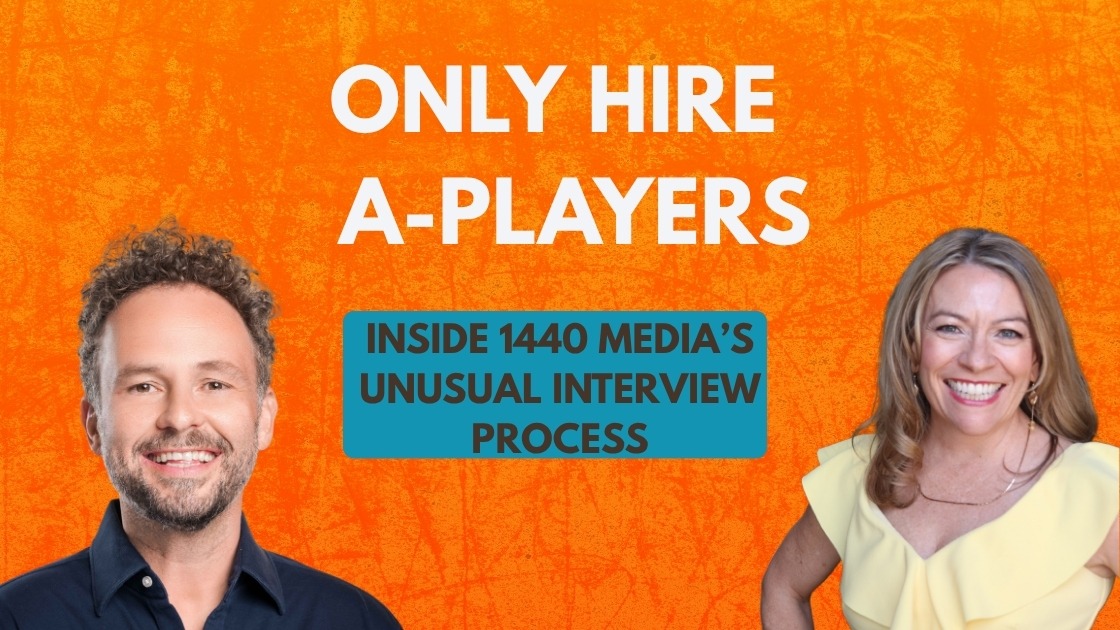
What happens when you treat hiring and culture as critical drivers of business performance rather than simply HR functions?
Tim Huelskamp, CEO of 1440 Media, joins this episode of How I Turned the Corner to share the people strategy behind one of the country’s most widely read daily newsletters.
1440 began with just 78 friends and family and has grown into a news and knowledge platform reaching nearly 5 million readers. Behind that growth is a deliberately designed culture centered on curiosity, high performance, transparency, trust, and employee autonomy.
Before 1440, Tim spent a decade in private equity, where he saw firsthand how dramatically the right leader and team could change the trajectory of a business. His biggest takeaway? Business models, products, and markets matter—but exceptional people can be one of the most powerful drivers of company value.
In this conversation, Tim explains the three things 1440 looks for when hiring: genuine passion for the work, intellectual horsepower and curiosity, and strong alignment with the company’s culture.
He and Kendra also dig into the realities of building a fully remote company. Tim explains why 1440 gives employees significant agency over when and where they work, how the company uses off-sites to create meaningful in-person relationships, and why a remote-first model has dramatically expanded its available talent pool.
Then Tim takes us inside one of the most interesting parts of 1440’s hiring process: a paid mock board meeting.
Rather than relying solely on traditional interviews, candidates are given an opportunity to dig into the business, develop ideas for their potential role, and work through those ideas with 1440’s senior leaders. It gives both sides something ordinary interviews often can’t: an opportunity to experience what working together might actually feel like.
The result is a fascinating conversation about what it means to identify great talent, build trust, give people autonomy, and create an environment where high performers can do exceptional work.
In this episode, you’ll learn:
-
The three qualities 1440 prioritizes when hiring
-
What Tim learned about people and performance during a decade in private equity
-
Why passion for the work can be difficult to replace
-
How transparency develops stronger, more invested employees
-
How 1440 approaches culture on a fully remote team
-
Why autonomy can become a recruiting advantage
-
How remote work expands a company’s available talent market
-
Why bad hires can be particularly costly for small businesses
-
How 1440’s paid mock board meeting works
-
How leaders can evaluate culture fit through behaviors rather than predictable interview questions
View Transcript
Transcript — How I Turned the Corner, hosted by Kendra Prospero
Kendra: Today’s guest runs one of the most widely read daily newsletters in the country. Tim Huelskamp is the CEO of 1440 Media, a bootstrapped media company that delivers balanced, fact-based news every single day. What I love about Tim is that behind the impressive newsletter is a real commitment to building a high-performing culture — one rooted in intellectual curiosity, ownership, and making sure people do their best career work while they’re there. And he’s done all of this with a fully remote team. Tim, welcome to How I Turned the Corner.
Tim: Thank you, Kendra. Super honored to be here with you.
Kendra: Yeah, it’s great. So, because this is a bit of an unusual guest for us — we haven’t really had media on the podcast before — I would love to just showcase a little bit about your newsletter. I’m a recent reader of it, so I’d love for you to share with our listeners a little more about what you try to do with 1440 Media.
Tim: Yes. So 1440 is a news and knowledge platform for the insatiably curious. We started this company about eight years ago because we had this pain point: we love learning, we’re curious people, and we felt like the media landscape wasn’t delivering for us in a couple ways.
One, all this knowledge is scattered across the internet, and there tend to be nichy newsletters — sports, politics, culture, technology — and we always said, why can’t someone bring it all together for us? Describe what’s going on in the Middle East, what’s going on with the SpaceX IPO on Friday, who the latest Michelin star recipients are, what fall foliage schedules look like. Just a little bit of everything — knowledge serendipity, things you maybe wouldn’t have thought you wanted to learn about that morning, but curious people love that.
And the second problem was all the vitriol and misinformation that plagues a lot of internet content. Busy people who are truly curious don’t want to spend time sifting through that. They just want a safe place to learn and grow their brains. That’s why we started 1440 — to solve those two problems. We started with 78 friends and family a few years ago and just iterated on the product quite a bit. Today we have almost 5 million readers spread across the United States. They’re 50/50 male-female, a third have a graduate degree, and interestingly they’re roughly a third Democrat, a third Republican, and a third independent.
So it’s people looking for knowledge, not everyone yelling at each other on the two poles that get really loud on social media. Most are just busy professionals with kids at home who love learning and want someone to help them learn — and that’s what we do better than anyone. I’m biased there, but I think what we do really well is we have curious people who really enjoy their work, are very passionate about their jobs, and are learning every day — and then we take that knowledge and ship it out in service of others so they can learn as well.
Kendra: Well, it’s interesting, because we work with job seekers — I help a lot of people who are on a job hunt — and I’ll say that one of the most toxic environments is typically media companies. Some of my saddest stories have come from former reporters and media-room type people. So I was so excited to chat with you, because you’re not only creating this amazing newsletter, you’ve got this incredible culture. Why was this such a focus for you? It’s not something I’d think you’d just grow up with inside the media industry.
Tim: Yeah, I think one of our advantages was that most of us aren’t from the media world — we’re kind of outsiders who came in. Since then we’ve hired editors from Bloomberg and other places, but when we started we didn’t have any media experience on the team. I actually came from the private equity world — I did financial transactions for about a decade before this.
My favorite thing I learned there: we had a $20 billion publicly traded private equity fund, 300 companies, and one of my jobs was going into a broken company and helping fix it. We went back and looked at what the biggest driver of company value was — before we invested in companies, and then once they exited, and looked at the difference. By far the single most important thing you could do is hire the right team.
Kendra: Yes.
Tim: And yet, how often does private equity look at that in the due diligence phase? Never.
Kendra: Right. But that’s great that you guys were doing that.
Tim: Yeah, I think we were different among the private equity firms at the time, and I really saw that firsthand. We’d have companies with 300 employees, a dictatorial CEO who usually surrounds himself with B players or C players because he wants people saying yes to him. You’d walk into these environments where, literally for a decade, people would not be open, not be available to share their ideas. They weren’t rowing in the same direction — just really broken cultures.
My favorite thing was we would drop in one of our excellent CEOs — my favorite one was named Kim — and you’d come back to that business three months later, same 299 people with one new leader, and it’s a completely transformed company. Because she was so passionate about opening up ideas, getting everyone rowing in the same direction, changing the compensation structure, changing the culture around working at all hours and burning the midnight oil.
That was the biggest thing I learned in private equity: the business model matters, the product matters, the market matters, but the single biggest unlock of value is how you treat your people. Actually, I’d even go back further — how you recruit your people, how you train your people, how you help them grow into the roles they want to become. The most important thing you can do as a founder is create an environment where incredible people want to come work with you, and then get out of their way and let them thrive professionally. I saw that firsthand in my decade in private equity, and I tried to take that ethos into what we built at 1440.
Kendra: Well, I would validate everything you just said completely with what we see with our clients too — the ones that systematize hiring, training, and managing, and actually treat it as a business function that delivers to the bottom line, are the ones that see the biggest results. So — I don’t want to repeat what you’ve said on other podcasts, but what was the origin for you to get so clear on your values? How did you determine them?
Tim: Yeah. I think it’s a combination of my work experience in private equity, and — my team makes fun of me for this — I have a slight obsession with studying other founders in the space, both historically (Andrew Carnegie, Jeff Bezos, Oprah) and modern founders like Melanie Perkins at Canva. There’s really cool information out there about how they built their companies successfully, and I study that all the time.
One of the things I’ve learned over the years is they’re all basically saying the same thing on the people side. Hire and develop world-class people, pay them above market, and get out of their way. Make sure you’re hiring people who enjoy the work they do — not every one of the 40 hours a week is going to be lovable, but you want people who are passionate about the work they’re doing. If you’re hiring a social media person, you want someone who gets lit up by social media, who loves the intricacies and nuances of it.
I also think the importance of being a servant leader and having an open culture where people can learn from each other matters. One of the things we’ve taken from a lot of these founders is being a super transparent organization — almost every number we have as a company is shared with our team, and everyone understands why we’re doing every initiative. On our Monday calls, we share literally everything the company’s doing, split across every other week. Our 24-year-old seller who just joined understands why growth is doing its strategy, what the product strategy is, what the brand strategy is.
What we’ve found is the more you can teach people about why the company is doing things, and connect the dots for them, it not only makes them a better seller or better at their specific role, it also makes them more invested in what you’re building as a company. When I was younger there were a lot of rooms I probably shouldn’t have been in, but I had wonderful mentors who pulled me into those rooms so I could learn different strategies — in hindsight, they were developing me to be a better employee, a better colleague, and setting me up for my future. We want to make sure we’re doing the same thing here. On some of our Monday meetings we have conversations on strategy that would normally happen in boardrooms, and we’re having those because I want people to understand why this is our vision and where we’re going — our north star — but also so they can learn that for their own development. It’s an investment in them, and it really pays back, because they’re invested in the company and what we’re doing, and we’re investing in their future too. If they want to start a company one day, or go off and do something on their own, we’re teaching them those skills. We find that’s actually a big differentiator in the market — you’re not just coming here to be a seller, you’re coming here to be a great seller, but you’re also learning product skills, growth skills, and board-level strategic skills.
Kendra: So let’s tie this into your remote team. As you’ve probably seen — because you’re a news junkie like I am — the last couple months there have been a lot of articles about the negative side of remote work, especially for a younger team, that they’re the ones missing out the most, according to some of these articles, on the in-person office experience. How are you doing that? You just onboarded and brought in this new 24-year-old salesperson — what’s the experience like with everyone remote?
Tim: Yeah, we do this a couple ways. One, we have tons of Zoom sessions and Google Meets throughout the week — one-on-ones, team meetings to discuss strategy, our team meeting every Monday. We’re also big fans of off-sites — we’ve been doing those since the beginning. We do two big ones a year: one in the winter, just our colleagues, for a week; and one in the summer where we actually invite your significant other, if they’d like to join. They don’t have to, but we’ve found that the bond you create with the significant others — getting to meet each other and spend time together — makes it a really special time.
We also do smaller team off-sites — our sales team gets together, our growth team gets together, our editorial team gets together — because there is a lot of value in being together, but with 27 colleagues all over the country, let’s bring them together for that special time. When we do the off-sites, the majority of the time is actually just hanging out. The more we’ve done these, the more we’ve realized: let’s talk about strategy, our future, where we’re going in the next decade, but let’s leave time for those special bonds to be built in real life.
I will say, we’re still figuring it out — I do wish we had more in-office time. I don’t think being in the office five days a week is the best approach, but I do wish we had more time. It’s also part of our recruiting strategy — we look for people who want remote work, who are incredible at their job and have two kids at home and don’t want to be on the train for three hours a day, and want that flexibility. We call it our talent TAM — total addressable market. By providing that structure, it really opens up our talent TAM. We’re headquartered in Chicago, where I live — the Chicago MSA is 3% of the United States. Now we can get 100% of the United States. Our talent TAM considerably opens up. It’s maybe not for everyone, but I think it’s a growing trend for the types of people who want that flexibility, who can be wonderful parents and have free time throughout the day, as long as they get their work done. That’s how we’ve built the company — I’m not saying it’s right for everyone, but it’s given us a lot of advantages on our talent TAM.
Kendra: Yeah, we’re an all-remote company too, and have been since day one, and I’ve found it to work really well. But I think what makes it different from a traditional office environment — and the leadership of an office environment — is that you have to be more intentional when you come together, not just about what you’re doing, but even about who is there. My husband’s former company had a mandate for two days in office, but it wasn’t the same two days for everyone, so there’d be times he’d show up and be one of two people there — a waste of a shower.
Tim: Yeah, you hear a lot of these horror stories where people go into the office and just sit on Zooms all day because they’re the ones in the office.
Kendra: Exactly. That doesn’t make sense. But I think, in the theme of having to change the way we lead to keep up with what our modern workforce needs — this is one of those areas: trying to find ways to give people more agency over their schedule. So maybe they’re not traveling on the train, and they’re using that time productively, whether that’s spending time with family or meeting the company’s objectives. As long as those things are being met, it doesn’t matter when or where it’s happening. Giving people that agency is still a really important part of what’s needed now and into the future — and it sounds like you’ve got a really good way of managing that.
Tim: Couldn’t agree more. My co-founder Drew wakes up every morning, works a little bit, walks his daughter to school, goes to the gym from 12 to 1 every day. We have a policy: as long as you get your work done, we don’t care. One of the things that’s been interesting, having some senior folks who’ve come from other industries where that wasn’t the case — in the beginning, maybe month two or three, they’ll send me a Slack meaning well, saying, “Hey Tim, I have to go pick up my kids from school at 4:00, just FYI.” And I’m like, I appreciate you saying it, but you don’t need to tell us that — just get your stuff done. We trust you, we believe in you, you have the agency. Go manage your work-life balance accordingly.
Kendra: Yeah, exactly. It is interesting when new people join my team — the first few weeks they’re like, “Is this for real? Are you sure?” And I’m like, yeah, it takes a little time, but I promise you, I don’t really care what happens. I care, but I don’t care.
Tim: Yeah. Well, let’s talk a little about the kinds of people you’re really looking for on your team. In media, obviously you want people who are extremely smart and curious, but what are some of the fundamental deal-breakers — things you will not bring onto the team?
Tim: We look for three things when we hire — really breaks down to three. One, as I said, passion and love for the work. Do you get lit up by whatever job you have? You can’t replace that. If someone’s deeply passionate about, say, social media or paid acquisition, people who love their work and find deep passion in it will go the extra mile — they’ll come up with ideas you could never have imagined. That’s the biggest one.
The second is what I call horsepower — intellectual horsepower. Are they brilliant? Are they deeply curious? Do they love learning? When you meet them on a Zoom or in person, do they blow you away with their brilliance within the first few minutes? If they don’t, I always say just politely move on. That doesn’t mean, by the way, they need a certain degree or college education — we have a couple people on our team who didn’t go to college, but they’ll blow you away with their brilliance. It’s really understanding how smart they are.
Unfortunately, with those two, sometimes you get really passionate, brilliant people who can be terrible cultural fits. So the third is culture fit — is everyone a kind, caring, curious human who sees the world the same way we do? Sometimes we meet really smart people who would just ruffle feathers, who wouldn’t be a good culture fit. That’s what our interview process is for — hanging out with them, getting to know them. Would they be a great addition to our company off-sites? Do they see the world the same way? When you package those three — love for the work, brilliance, and great culture fit — that’s where you really get superstars.
Kendra: Yeah. In some of the former podcasts I’ve read or heard with you, you talk a lot about “A players hire A-plus players and B players hire C players.” Can I dispel one thing about that, or talk with you about it? I’ve worked with thousands of people, and I’m a pretty judgmental person too, but what I’ve learned after all these years is that I really believe everyone has a gift to give this world. So I don’t really think of people as a B player or a C player anymore — I just think of them as not in the right job. Is that fair, or am I being naive? With your experience, especially in private equity?
Tim: It’s a great question. I think the difference might be, when you’re at a small company — we do over a million in revenue per employee, and we’re a very flat organization, so everyone has to be a high performer here. If 1440 gets to hundreds or thousands of employees one day, if we hired someone who wasn’t a perfect fit for that role, but there was another role they were a perfect fit for, and they had those three things, could they adjust into that role? Perhaps. I don’t know — it’s a great question. What’s your take on it?
Kendra: Well, I just believe everyone has a gift, and maybe it’s not for my company — I’m not saying they all belong here — but I think, given a clear understanding of what you’re great at, what your deal-breakers are, what you’re willing or not willing to live with in a company culture or the job itself, and a clear idea of why you even work — because, like you said, some days are going to be hard, you can’t expect 40 hours a week to be blissful, so it’s helpful to know why you’re working and what you’re aiming for. When those three things come together for people, they find a job that aligns with all of it and they’re happy. I was a software engineer before this — I was a B player. Maybe I try to justify this because I wasn’t very good at it, I wasn’t wired to get up every day excited to code. Does that make me a B player across everything? Of course not.
Tim: Yeah, I think that’s a good point — I agree with that. I think everyone can be an A player in the right environment.
Kendra: You do? Okay.
Tim: Yeah, but I think the difference is, from our perspective, when you’re building a company that’s very small, you need A players in every role. And if someone isn’t an A player, maybe it’s actually serving them by allowing them to realize, hey, maybe you shouldn’t be a software developer — go build something new. But that doesn’t mean it’s the company’s job to always find that for them. At our size, we’re not big enough to shift people around into totally different careers, so we try really hard to spend most of our time upfront in the hiring process, making sure we’re finding the right A players for that specific role.
Kendra: Yeah, I’m in total agreement with you. I think especially small businesses can’t afford a bad hire — it erodes the bottom line so quickly, which always shocks me. Why isn’t there more of an automatic process to hiring for small businesses, given how expensive a bad hire is? But can I walk you through how we do our hiring?
Kendra: I would love it.
Tim: It’s a lot of stuff I learned in private equity, and I’d love to share it with your audience if it’s helpful. In private equity, one of the things we learned — we had a $20 billion fund, and the difference between a 10% and a 12% return on your money is hundreds of millions of dollars. So we spent a ton of time on the hiring process. One best practice we borrowed from private equity, and still do here at 1440: we have the first-round interview, and typically I take that one. As we’ve gotten bigger we’ll adjust slightly, but for a VP-level role I want to take the first one after they’ve been screened, because I want them to understand our vision and mission and where we’re going as a company — a bit of selling in that first interview. Then in the second half of the call I flip it to them: walk me through why you love social media, walk me through your background. A lot of the time, if you’re on with the CEO or a very senior person and they don’t ask incredible questions, that’s a signal — I’ll be very polite about it, but that’s the first strike. If you’re trying to leave your job for a new one and you don’t have thoughtful questions about the company’s strategy or how you’d fit into it or build on it, that’s the first one I’m quietly noting, though it’ll happen politely at the end of the call.
Then we have multiple rounds where they meet the rest of the team. But the biggest learning we took from private equity was the mock board meeting. Say it’s for our VP of Social — we say, we’d like you to bring your vision, your 90-day plan, and your three-year vision for the organization. And because your time is valuable, we’ll pay you for it — usually about $150 an hour, let us know how much time you spent. We’d love to meet you in two weeks. We sign an NDA and send them our board decks — they can ask for any information they want. It lets them dive into the company and learn more about it, and it also shows us their skills: are they a good presenter? Do they have strategic vision? How do they interact with colleagues?
We schedule a mock board meeting, about 90 minutes, sometimes longer depending on seniority, where the person presents their vision and we bring all the senior leaders of the company onto the call — sales, product, growth, people. They’ll almost do an audit of the business and tell us how they’d take it to the next level. It’s a wonderful exercise because you get to see how their brain works, their strategic chops, and they also get a sense of what it’s like working with us, because all the senior leaders are on the call, asking questions, problem-solving together for 90 minutes. It’s been a really awesome experience for us. And fun fact — we’ve never had anyone go through our full process, receive an offer, and not accept it. Because they’ve gotten to know the company through studying it and presenting on it, and they end the interview process feeling like they already know what it’s like to work there — they’ve spent a couple hours actually working with our head of product, our head of sales — and it creates this really special environment.
Kendra: Now, how about for junior-level people, like the sales guy you just brought on?
Tim: We do a similar process, just a bit shorter — maybe a 60-minute call. Not the three-year vision for the sales organization, but what would be your prospecting strategy. You have to make the deliverable commensurate with the level of work they’ll be doing — it’s not fair to ask someone straight out of college what their sales strategy should be. We’ll dial it up or down for the specific role, but we do the same process for every person we’ve ever hired.
Kendra: Yeah, that’s interesting, that’s great. I think probably what most companies miss out on — and you’re getting it as a byproduct of that experience — is really interviewing for culture fit, but not in a way where you just ask, “Do you have integrity?” as if it’s a value. Nobody’s going to say no. You can’t really get a feel for how they think about what the root really is behind what you want to see in someone with high integrity — what’s the behavior? That’s the part I think you’re seeing in those mock boardroom meetings — you’re seeing the culture fit through their actions and behaviors. You can also get there by asking really specific questions about the behaviors you want, but you have to ask them in a way where they don’t know what the “right” answer is — they have to draw from their own vocabulary, describe their own way of being, and you’re listening for the right behavior. That’s the part that’s a little more challenging for people to wrap their arms around. But that’s really neat — I’m glad it’s working for you, because you’ve obviously built an incredible company. I think that’s a perfect place for us to end here. I can’t wait to chat with you again when you’re at, I don’t know, 60 million subscribers in a couple years. What do you think?
Tim: That’d be lovely — can’t wait to come back and tell you how our people practices led to that success.
Kendra: I would love that, that’d be great. Well, Tim, thank you so much for joining me on How I Turned the Corner. It was great to have you.
Tim: Thank you so much for the time. And actually, real quick — if I can be helpful to anyone, I’m at [email protected] (please verify this contact email before publishing — auto-transcription may not have captured it accurately). If anyone has a question, or I can serve in any way, we’d love to be helpful however we can.
Kendra: Yeah, and we’ll put all this information in the show notes too, so people can follow, subscribe, and get in touch with you.
Tim: Excellent. Love it. Thank you so much for the opportunity.
Kendra: Yeah, thank you.