
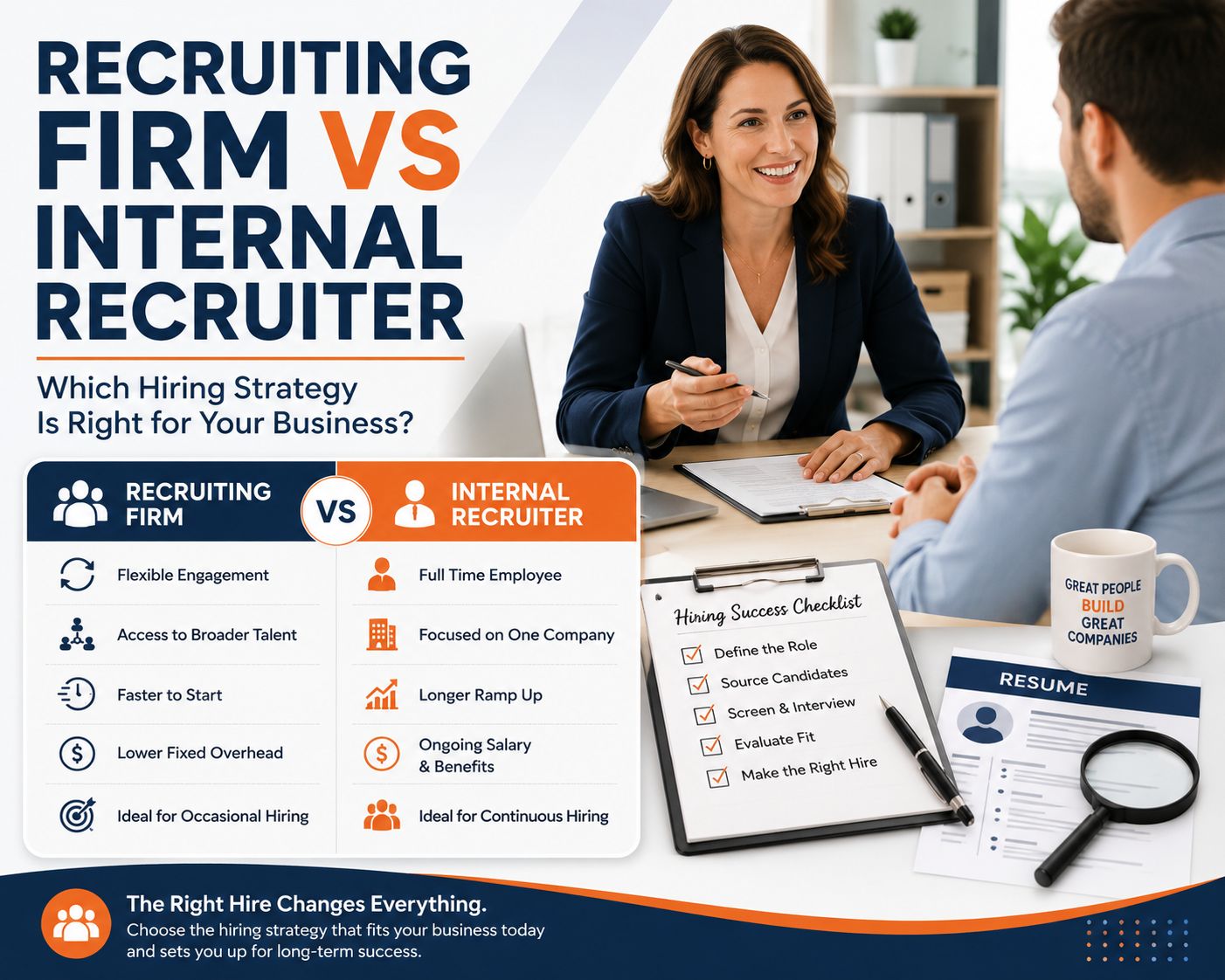
A recruiting partner is often the better choice when your business needs help filling important roles but does not have enough steady hiring volume to justify a full time internal recruiter. An internal recruiter may make more sense when hiring is continuous, predictable, and substantial enough to support a dedicated employee.
The right choice depends on how often you hire, the types of positions you need to fill, how quickly you need results, and the recruiting expertise already available inside your organization.
Quick Answer: Recruiting Partner vs Internal Recruiter
Choose a recruiting partner when you need flexible support, specialized expertise, broader candidate access, or help filling occasional and difficult roles. Hire an internal recruiter when your company has enough continuous hiring activity to justify a full time employee focused exclusively on your organization.
What Is a Recruiting Partner?
A recruiting partner is an outside professional or firm that works with your organization to define positions, attract qualified candidates, manage the hiring process, and help leaders make stronger hiring decisions.
The relationship should go beyond sending resumes. A strong recruiting partner learns your business, understands the position, represents your company professionally, and helps create a better experience for both candidates and hiring managers.
Recruiting support may include:
- Position and job description development
- Recruiting strategy
- Candidate sourcing
- Passive candidate outreach
- Resume review
- Candidate screening
- Interview coordination
- Interview structure and guidance
- Candidate communication
- Finalist evaluation
- Offer development
- Hiring process improvement
A recruiting partner can support one difficult search, several open positions, or an ongoing hiring need without becoming a permanent addition to payroll.
Learn more about recruiting services from Turning the Corner HR.
What Does an Internal Recruiter Do?
An internal recruiter is a full time employee who recruits exclusively for one organization.
The recruiter may work closely with leadership, department managers, HR, and marketing to support hiring across the company.
An internal recruiter may be responsible for:
- Managing open positions
- Writing and posting job advertisements
- Sourcing candidates
- Reviewing applications
- Conducting initial interviews
- Coordinating hiring teams
- Managing candidate communication
- Supporting employer branding
- Building ongoing candidate pipelines
- Tracking recruiting data
- Supporting onboarding
An internal recruiter can develop deep knowledge of the organization, its culture, leaders, departments, and long term workforce plans. That can be valuable when the business has enough ongoing recruiting work to keep the role fully utilized.
Recruiting Partner vs Internal Recruiter: Key Differences
| Factor | Recruiting Partner | Internal Recruiter |
|---|---|---|
| Employment structure | Flexible outside partner | Full time employee |
| Cost structure | Pay based on the search or engagement | Salary, benefits, payroll taxes, software, and equipment |
| Flexibility | Support can increase or decrease as hiring needs change | Fixed full time role |
| Candidate reach | Often provides broader networks and active sourcing | Focused on the needs of one organization |
| Speed to begin | Can begin quickly with established tools and processes | Requires recruiting, hiring, onboarding, and ramp up |
| Specialized searches | Can bring expertise for leadership, confidential, or difficult roles | Experience depends on the individual recruiter |
| Best fit | Occasional, specialized, leadership, or difficult hiring | Continuous and predictable hiring volume |
When a Recruiting Partner Is Usually the Better Choice
1. You Hire Only a Few Important Positions Each Year
Many growing businesses need experienced recruiting support but do not hire enough people to keep an internal recruiter busy throughout the year.
A recruiting partner gives the company professional support when positions open without creating permanent overhead during slower periods.
2. Your Managers Do Not Have Time to Recruit
Recruiting often becomes an extra responsibility for executives, department leaders, or HR employees who already have full workloads.
They may post a job and review applications, but successful recruiting also requires sourcing, candidate outreach, screening, communication, scheduling, interview coordination, and follow up.
A recruiting partner manages the process so leaders can focus on evaluating strong candidates rather than trying to find them.
3. You Need Specialized or Leadership Talent
Executive, leadership, technical, and specialized positions are often difficult to fill through job postings alone.
An experienced recruiting partner can identify passive candidates who are not actively applying but may be open to the right opportunity.
4. Hiring Has Become Too Slow
Long hiring processes increase the risk that strong candidates will accept other offers. They also leave teams understaffed and place more pressure on current employees.
A recruiting partner can improve role definition, candidate sourcing, interview coordination, and decision making so the process moves more efficiently.
Explore nine common reasons recruiting efforts fail to produce the right candidates.
5. Your Current Recruiting Efforts Are Not Producing Qualified Candidates
A high number of applicants does not necessarily mean a strong candidate pool.
If hiring managers are spending hours reviewing applicants who do not meet the requirements, the sourcing strategy, job description, compensation, or selection process may need to change.
6. You Need Recruiting Support That Can Scale
Hiring needs often change throughout the year. A business may need little support for several months, then suddenly need to fill multiple positions during a period of growth.
A recruiting partner can adjust to those changes without requiring the company to add permanent overhead.
7. You Need an Objective Outside Perspective
Internal teams can become attached to an outdated job description, unrealistic list of qualifications, or compensation range that no longer matches the market.
An outside recruiting partner can help leadership evaluate the position honestly and develop a more realistic hiring strategy.
When Hiring an Internal Recruiter May Make More Sense
1. Hiring Is Continuous and Predictable
An internal recruiter may be appropriate when the company hires every month and expects that level of activity to continue.
The organization should have enough consistent recruiting work to support the role even when individual searches slow down.
2. The Company Has Multiple Locations or High Volume Roles
Organizations with several locations, large hourly workforces, or continuous hiring pipelines may benefit from a recruiter who is fully dedicated to the company.
3. Recruiting Is Closely Integrated With Daily Operations
An internal recruiter can build strong relationships with hiring managers, attend regular workforce planning meetings, and stay closely connected to changing staffing needs.
4. The Business Is Building an Internal Talent Acquisition Team
A full time recruiter may be the first step toward creating a larger internal recruiting function with coordinators, sourcers, employer branding support, or recruiting leadership.
5. Leadership Wants a Dedicated Internal Resource
Some organizations prefer to have a recruiter available every day for hiring manager meetings, workforce planning, candidate communication, and internal projects.
The Cost of a Recruiting Partner vs an Internal Recruiter
The comparison should include more than a recruiter’s salary.
An internal recruiter may require:
- Salary
- Payroll taxes
- Health insurance
- Retirement benefits
- Paid time off
- Bonuses
- Recruiting software
- Job board subscriptions
- LinkedIn recruiting tools
- Technology and equipment
- Training and professional development
- Management time
A recruiting partner typically provides its own sourcing tools, systems, processes, candidate networks, and recruiting expertise as part of the engagement.
The best financial choice depends on hiring volume. A full time recruiter may be cost effective when the organization is hiring continuously. A recruiting partner may provide better value when hiring is occasional, specialized, urgent, or difficult.
Access to Active and Passive Candidates
Job postings primarily reach people who are actively searching. Some of the strongest candidates are already employed and are not regularly reviewing job boards.
Experienced recruiters build professional networks and conduct direct outreach to people whose skills and backgrounds align with the position.
This active sourcing approach can create a stronger candidate pool, particularly for leadership and specialized roles.
How a Recruiting Partner Can Improve Hiring Speed
Every week an important position remains vacant can affect productivity, customer service, revenue, and employee morale.
A recruiting partner can help improve speed by:
- Clarifying the position before the search begins
- Improving the job description and candidate message
- Developing a realistic sourcing strategy
- Proactively reaching qualified candidates
- Screening for experience and fit
- Coordinating interviews
- Maintaining candidate communication
- Helping hiring managers evaluate finalists
- Supporting the offer process
Speed does not mean rushing the decision. It means removing unnecessary delays while maintaining a thoughtful selection process.
Advantages of an Internal Recruiter
An internal recruiter can develop a deep understanding of the company, including its culture, leadership, departments, and long term workforce plans.
Additional advantages may include:
- Daily access to hiring managers
- Consistent focus on one employer brand
- Knowledge of internal career paths
- Long term candidate pipeline development
- Close coordination with internal HR
- Support for continuous hiring needs
These advantages are most valuable when the business has enough ongoing recruiting work to fully use the role.
Can a Recruiting Partner and Internal Recruiter Work Together?
Yes. The decision is not always one or the other.
An internal recruiter may manage ongoing hiring while an outside recruiting partner provides additional support for:
- Executive searches
- Specialized positions
- Confidential searches
- Sudden hiring increases
- Difficult geographic markets
- Positions that have remained open too long
- Temporary recruiting capacity
This combination gives the company internal continuity and outside reach when the internal team needs more expertise or capacity.
Common Recruiting Mistakes
Waiting Until Hiring Becomes a Crisis
Many companies wait until a position has been vacant for months or an employee has already left before improving the recruiting process.
Starting earlier gives the business time to define the position, build a candidate pool, and make a thoughtful decision.
Treating Recruiting as Job Posting
Posting a job is only one part of recruiting.
Strong results require position strategy, sourcing, screening, communication, interviewing, candidate evaluation, and offer management.
Using an Unclear Job Description
An unclear or unrealistic job description can attract the wrong applicants and discourage strong candidates.
The position should clearly explain responsibilities, priorities, qualifications, compensation expectations, and what success looks like.
Creating a Slow Interview Process
Strong candidates often have several opportunities. Long gaps between interviews, unclear next steps, and delayed decisions can cause the company to lose them.
Choosing Only by Recruiting Fee
The least expensive recruiting option may become costly if it produces weak candidates, extended vacancies, repeated searches, or a poor hire.
Compare experience, sourcing approach, communication, process, and results rather than evaluating the fee alone.
Learn more about the hidden costs of a poor hiring decision.
Questions to Ask Before Choosing a Recruiting Partner
- What types of roles do you recruit for?
- Who will manage our search?
- How do you learn about our company and culture?
- How do you find passive candidates?
- How do you evaluate candidates?
- What does your recruiting process include?
- How often will we receive updates?
- How do you represent our company to candidates?
- What support do you provide during interviews?
- How do you help with offer development?
- What happens if the search is difficult?
- How do you measure recruiting success?
What a Trusted Recruiting Partner Should Do
A trusted recruiting partner does more than send resumes. The partner learns the business, understands the role, represents the company professionally, and helps leaders make stronger hiring decisions.
The relationship should improve both the candidate experience and the hiring manager experience.
A strong recruiting partner should help the company:
- Define the position clearly
- Develop a realistic recruiting strategy
- Reach qualified active and passive candidates
- Improve interview consistency
- Maintain candidate communication
- Evaluate finalists thoughtfully
- Reduce unnecessary hiring delays
- Create a competitive and appropriate offer
Frequently Asked Questions
What is the difference between a recruiting partner and an internal recruiter?
A recruiting partner is an outside provider that supports hiring as needed. An internal recruiter is a full time employee dedicated to one organization. The better choice depends on hiring volume, role complexity, budget, and the expertise required.
Is a recruiting partner the same as a staffing agency?
Not always. Some staffing agencies focus on temporary or high volume placements, while recruiting partners may specialize in direct hire, professional, leadership, or executive searches. Businesses should ask what types of roles and employment arrangements the provider supports.
Is a recruiting partner more expensive than an internal recruiter?
The answer depends on hiring volume. An internal recruiter creates ongoing salary, benefits, software, and overhead costs. A recruiting partner may provide better value when hiring is occasional, specialized, or difficult.
When should a company hire an internal recruiter?
A company should consider an internal recruiter when hiring is continuous, predictable, and substantial enough to support a full time employee throughout the year.
Can a recruiting partner find passive candidates?
Yes. Experienced recruiting partners use direct outreach and professional networks to identify qualified people who may not be actively applying to job postings.
Can a recruiting partner help improve our interview process?
Yes. A recruiting partner can help clarify the role, structure interviews, improve candidate communication, evaluate finalists, and create a more consistent hiring process.
Can we use a recruiting partner if we already have an internal recruiter?
Yes. A recruiting partner can provide additional capacity, specialized expertise, executive search support, or help with positions the internal team has struggled to fill.
Does a recruiting partner guarantee a successful hire?
No recruiting process can guarantee that every hire will succeed. A strong recruiting partner improves the quality of the process, candidate pool, evaluation, communication, and decision making, which can reduce hiring risk.
How do I know whether my recruiting process is working?
Look at how long positions remain open, the quality of applicants, candidate withdrawal rates, offer acceptance, hiring manager satisfaction, new hire performance, and early turnover.
Why Businesses Choose Turning the Corner HR as a Recruiting Partner
Turning the Corner HR helps growing organizations recruit people who fit the position, the team, and the business.
Our recruiting team supports clients with role definition, candidate sourcing, screening, interview strategy, candidate communication, selection, and offer development.
We act as a trusted recruiting partner, giving leaders the expertise and capacity to make stronger hiring decisions without adding a full time internal recruiter before the business is ready.
Our broader HR expertise also helps us understand how recruiting connects with compensation, onboarding, leadership, retention, performance, and workplace culture.
Explore our Client Success Stories.
Continue Reading
- Recruiting Services for Growing Businesses
- When Recruiting Is Not Working
- The Hidden Cost of Bad Hiring
- When Should a Small Business Hire HR?
- Fractional HR vs Hiring an HR Manager
Which Recruiting Approach Is Right for Your Business?
A recruiting partner and an internal recruiter can both be effective. The right choice depends on how often you hire, the types of positions you need to fill, the expertise available internally, and the financial commitment the business is ready to make.
Every organization reaches this decision at a different stage. The right approach should support your hiring needs today while remaining flexible enough to support future growth.
Schedule a free consultation with Turning the Corner HR to discuss your hiring needs and determine whether an outside recruiting partner is the right fit for your organization.