
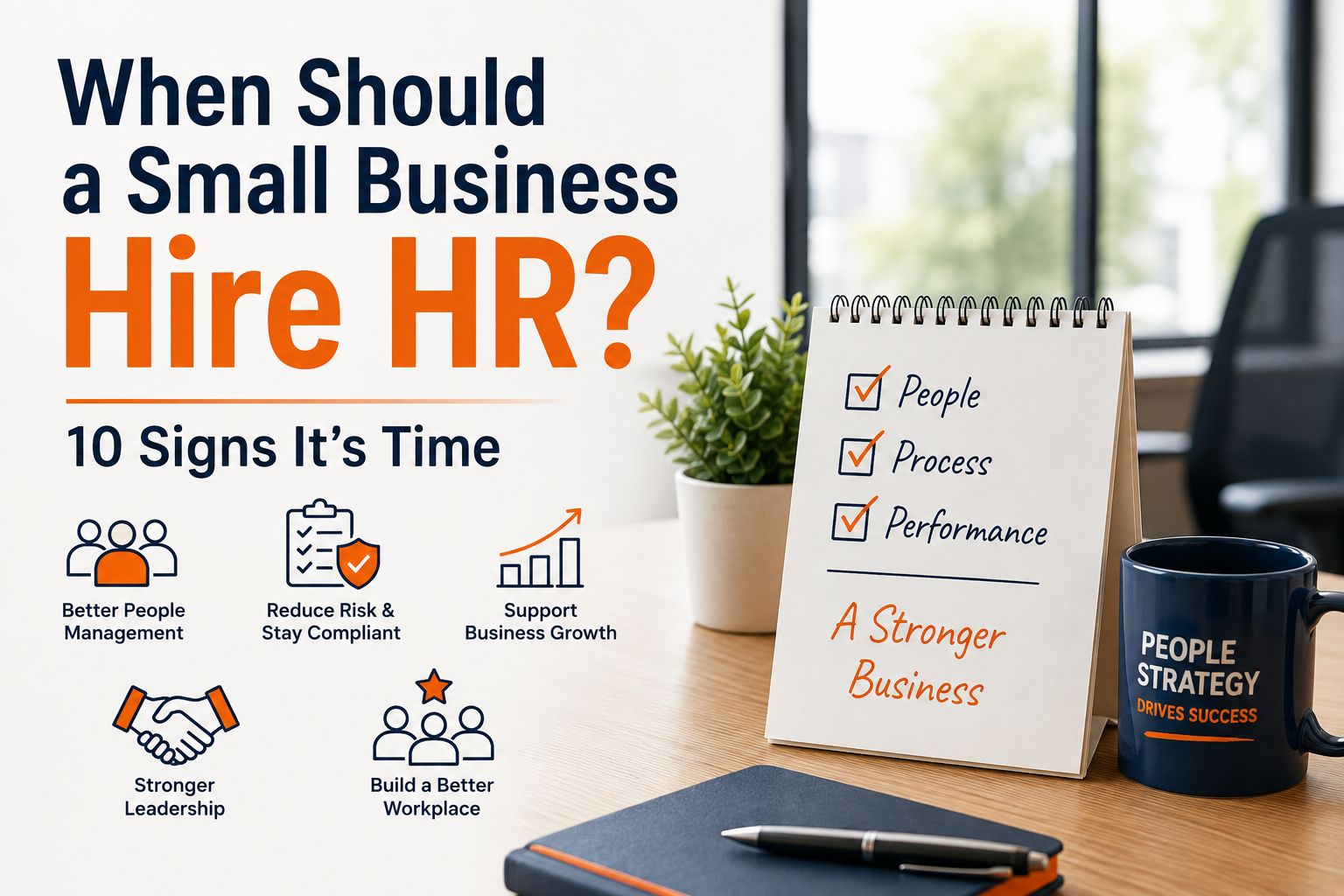
Most small businesses should hire HR when people management begins slowing growth, creating compliance risk, or making it harder to recruit and retain employees. The right time is based more on business complexity than a specific employee count. For many organizations, this happens between 20 and 50 employees, although fast growing companies may need HR support sooner. You do not necessarily need to hire a full time HR manager first. A trusted HR partner can provide strategic guidance, practical support, and experienced HR leadership at the level your business needs today.
Quick Answer: When Should a Small Business Hire HR?
Most small businesses should hire HR when people management begins taking time away from running the business. While many companies reach this point between 20 and 50 employees, rapid growth, hiring challenges, compliance concerns, employee relations issues, multistate expansion, or inconsistent management may mean it is time to work with a trusted HR partner sooner. Fractional HR can provide experienced HR leadership during this growth stage without requiring the business to hire a full time HR executive before it is ready.
You Do Not Hire HR Because You Are Big. You Hire HR Because Business Gets More Complex.
Small businesses often manage HR informally. The owner handles employee questions, managers make their own hiring decisions, and workplace policies develop as situations arise. That approach may work for a small team. It becomes harder to sustain as the company adds employees, managers, locations, legal requirements, and more complicated workplace situations.
Growth commonly creates new challenges involving:
- Recruiting and hiring
- Employee onboarding
- Performance management
- Employment law compliance
- Manager development
- Employee relations
- Compensation and benefits
- Workplace culture
- Employee retention
These are not simply HR problems. They are business growth challenges that affect productivity, profitability, risk, and the customer experience.
When Is It Time to Move From Informal HR to Fractional HR?
For many growing businesses, the transition to Fractional HR happens before the company needs a full time senior HR leader. Fractional HR can serve as a bridge between founder led people management and a future internal HR department or executive level HR hire.
Common operational triggers include:
- Rapid hiring: The company is adding employees quickly and existing hiring, onboarding, communication, and performance systems are struggling to keep up.
- Multistate expansion: Employees are being hired in new states, increasing the complexity of employment laws, leave requirements, wage rules, policies, and compliance obligations.
- Adding management layers: The company now has multiple supervisors or department leaders who need consistent guidance on performance, discipline, documentation, communication, and employee relations.
- Fundraising or preparing for investment: Investors, boards, lenders, or strategic partners may expect stronger HR infrastructure, documentation, compliance practices, and workforce planning.
- Crossing employee thresholds: Growth can trigger new federal, state, or local employment requirements that the business did not previously need to manage.
- Increasing employee relations issues: Complaints, performance concerns, leave questions, disciplinary situations, or workplace investigations are becoming more frequent or more complex.
- Leadership time is being consumed by HR: Owners and executives are spending significant time researching policies, resolving employee issues, handling hiring, or making people decisions instead of focusing on the business.
- The company needs senior HR expertise but not a full time executive: The organization needs experienced HR leadership, but there is not yet enough day to day work to justify a full time HR director or chief people officer.
Fractional HR is often the right next step when the business needs more than occasional HR advice but is not yet ready for a full internal HR leadership team.
10 Signs It Is Time to Bring in HR Support
1. You Are Spending More Time Managing Employees Than Growing the Business
Business owners frequently become accidental HR managers. They answer policy questions, resolve employee conflicts, manage performance concerns, and try to keep up with changing employment requirements. If people issues regularly take time away from clients, operations, strategy, or growth, it is time to consider professional HR support. Read seven additional signs that your company has outgrown DIY HR.
2. Hiring Has Become Inconsistent
Open positions stay vacant. Interviews are rushed or unstructured. Hiring managers ask different questions. Strong candidates accept other offers before your team makes a decision. An experienced recruiting partner can help you clarify the position, improve the candidate experience, structure interviews, and make better hiring decisions. Learn more about Turning the Corner HR recruiting services. Explore nine common reasons recruiting efforts fail to produce the right candidates.
3. Managers Handle Employee Situations Differently
Without consistent HR guidance, managers often create their own approaches to coaching, discipline, attendance, documentation, and performance management. Employees may receive different treatment depending on who manages them. This creates confusion, damages trust, and increases risk. A trusted HR partner gives managers a reliable source of guidance and helps the organization apply its policies and expectations consistently.
4. Compliance Questions Keep You Up at Night
Employment requirements become more complicated as a company grows. Common concerns include employee classification, wage and hour rules, leave requirements, workplace investigations, personnel records, required notices, and handbook policies. If you are relying on internet searches or outdated documents to make important employment decisions, professional guidance can help protect the business and its employees. Explore HR Compliance and Risk Management services.
5. Employee Turnover Is Becoming Expensive
The cost of turnover extends far beyond recruiting fees. It includes lost productivity, manager time, onboarding, training, overtime, customer disruption, and the effect repeated departures can have on morale. HR can help identify why employees are leaving and improve the systems that influence retention, including leadership, communication, recognition, compensation, career development, and workplace culture. Learn more about the hidden financial and operational costs of a poor hiring decision.
6. Your Company Is Growing Quickly
Businesses with approximately 20 to 200 employees often experience significant HR growing pains. Systems that worked for a team of ten may no longer work when the company has several departments, managers, or locations. Rapid hiring can also expose weaknesses in onboarding, communication, job descriptions, performance expectations, and leadership practices. Bringing in HR before those weaknesses become serious problems makes growth easier to manage.
7. Your Managers Need Leadership Development
Great employees do not automatically become great managers. Many are promoted because they are technically strong, then expected to lead without training or support. Leadership development helps managers communicate clearly, provide useful feedback, coach employees, address performance concerns, and build stronger teams. Explore leadership training and coaching from Turning the Corner HR.
8. HR Questions Never Stop
Paid time off. Performance concerns. Leave requests. Documentation. Employee complaints. Compensation. Hiring. Terminations. When every situation requires the owner or leadership team to start researching from scratch, the organization loses time and increases the chance of inconsistent decisions. A trusted HR partner already understands your business, people, policies, and goals. That context allows the partner to provide faster and more useful guidance.
9. You Are Constantly Reacting Instead of Planning
Reactive HR addresses the issue that happened today. Strategic HR helps the business prepare for what is coming next. That may include workforce planning, succession planning, compensation strategy, leadership development, recruiting plans, organizational structure, and employee retention. Learn how strategic HR consulting supports growing organizations.
10. You Want to Build a Better Workplace
Effective HR is not limited to compliance and paperwork. It helps a business create an environment where employees understand expectations, managers lead effectively, strong performers want to stay, and teams can do their best work.
Strong HR contributes to:
- Better hiring decisions
- Stronger leadership
- Clearer communication
- Higher employee engagement
- Lower turnover
- More consistent management
- Healthier workplace cultures
- More sustainable business growth
Should You Hire an HR Manager or Use Fractional HR?
Hiring a full time HR manager is not always the best first step. The right choice depends on the amount of daily support required, the complexity of the organization, and the level of expertise the business needs.
A full time HR manager may make sense when the company has enough ongoing work to support the position and needs someone available internally every day.
Fractional HR may be a better fit when the company needs experienced HR leadership and support but does not need, or is not ready to hire, a full time employee. It can also provide a bridge between founder led HR and a future internal HR leader by helping the organization build the systems, policies, management practices, and infrastructure that a growing business will eventually need.
Fractional HR can provide support with:
- HR strategy and planning
- Compliance and risk management
- Employee relations
- Manager coaching
- Performance management
- Policies and employee handbooks
- Compensation and organizational planning
- Recruiting and onboarding
- Leadership and workplace culture
Learn more about Fractional HR services. Compare Fractional HR with hiring a full time HR manager.
What Does a Trusted HR Partner Do?
A trusted HR partner does more than answer isolated questions. The partner learns how the organization operates, understands its goals, and helps leaders make better people decisions. The relationship should provide practical guidance today while strengthening the systems the company will need tomorrow.
A strong HR partner should be able to:
- Explain complex HR issues clearly
- Offer practical recommendations
- Identify risk before it becomes a crisis
- Support managers through difficult situations
- Improve recruiting and retention
- Align people strategy with business strategy
- Adapt support as the organization grows
Frequently Asked Questions
How many employees should a small business have before hiring HR?
There is no single employee count that applies to every business. Many organizations benefit from HR support between 20 and 50 employees, but companies may need help sooner when they are hiring quickly, operating in multiple states, adding new managers, experiencing employee relations concerns, or facing complicated compliance requirements.
What are the signs that a company is ready for Fractional HR?
Common signs include rapid hiring, expansion into additional states, adding management layers, increasing employee relations issues, growing compliance complexity, leadership spending too much time on HR, and needing experienced HR leadership without enough day to day work for a full time HR executive.
Can Fractional HR be a bridge before hiring a full time HR leader?
Yes. Many growing businesses use Fractional HR during the stage between informal founder led people management and a future internal HR department. A Fractional HR partner can help build policies, management systems, compliance practices, performance processes, and people strategy so the organization is better prepared when it eventually hires an internal HR leader.
Does a small business legally need an HR department?
A business may not be legally required to create an HR department, but it is still responsible for following applicable employment laws. The number of employees, business locations, and jurisdictions can affect which requirements apply.
Is Fractional HR better than hiring a full time HR manager?
Neither option is automatically better. Fractional HR can be an efficient choice for a growing company that needs experienced HR support without a full time hire. A full time HR manager may be appropriate when the organization has enough daily HR work to support an internal position.
How much does Fractional HR cost?
Fractional HR engagements at Turning the Corner HR typically start at $1,500 per month. The final investment depends on company size, complexity, growth stage, and the level of support required. Read our complete Fractional HR pricing guide.
What is the difference between HR outsourcing and Fractional HR?
HR outsourcing is a broad term that can include individual projects, administrative support, recruiting, compliance work, or other outside HR services. Fractional HR generally provides a more integrated and strategic relationship with ongoing leadership support. Compare HR outsourcing with Fractional HR.
Can HR help improve recruiting?
Yes. HR can improve job descriptions, interview structure, candidate communication, hiring decisions, onboarding, and workforce planning. Strong recruiting processes help a business attract better candidates and reduce costly hiring mistakes.
What does a trusted HR partner do?
A trusted HR partner helps a business manage immediate HR needs while improving long term people strategy. This may include recruiting, compliance, employee relations, leadership development, performance management, workplace culture, and organizational planning.
How can I tell whether my business is ready for HR support?
Look at how much leadership time is being spent on employee issues, whether managers are handling situations consistently, and whether hiring, compliance, turnover, multistate growth, or organizational complexity are creating recurring challenges. You can also take the free People Strategy Assessment to evaluate your current people practices.
Why Businesses Trust Turning the Corner HR
Turning the Corner HR serves growing organizations across the United States as a trusted HR partner. Since 2011, our experienced team has helped business owners, executives, and managers strengthen leadership, improve recruiting, reduce HR risk, manage employee relations, and build healthier workplace cultures.
Our services include Fractional HR, strategic HR consulting, recruiting, compliance and risk management, leadership development, training, and workplace culture support.
Turning the Corner HR does not process payroll or administer employee benefits. When clients need payroll, benefits, employment law, insurance, technology, or another specialized service, we can recommend trusted partners and collaborate with those providers.
Explore our Client Success Stories to see how we have supported other organizations.
Related HR Resources
- Fractional HR Services for Growing Businesses
- Fractional HR vs Hiring an HR Manager
- What Does Fractional HR Cost?
- HR Outsourcing vs Fractional HR
- 7 Signs You Have Outgrown DIY HR
- Why Growing Companies Choose Fractional HR
Ready to Decide What Kind of HR Support You Need?
Every business reaches this stage at a different time. The right solution depends on your goals, growth plans, current challenges, and existing HR resources. Take the free People Strategy Assessment to identify where your current people practices may need attention, or schedule a free HR consultation with Turning the Corner HR to discuss the right level of support for your business.