
Election 2024
To Speak or Not to Speak, That is the Question
During this presidential election season, business leaders are wondering what conversations should be tolerated in the workplace.
Regardless of their political beliefs, many feel that the 2024 presidential election is one of the most important elections in the history of the United States. It stands to reason that there will be – and already are – passionate discussions taking place regarding the candidates and the issues at stake during this election.
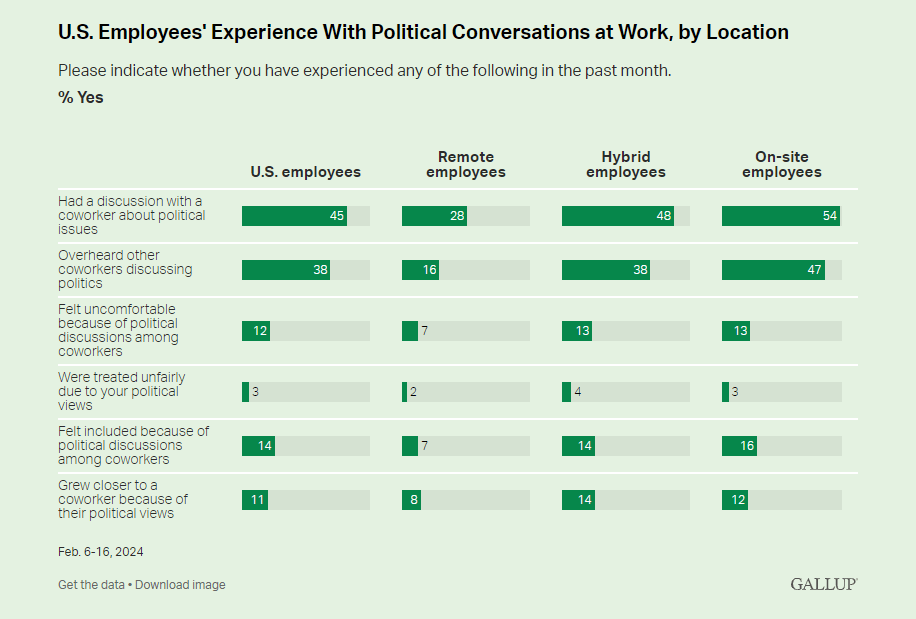
According to a February 2024 Gallup survey, 45% of employees stated that they had a discussion with a co-worker about political issues. Another Gallup survey in May showed that 57% of US adults have avoided sharing their political views due to fear of harassment or poor treatment. So, what are reasonable (and legal) expectations for political discussion in the workplace?
The Legal Side
First, let’s discuss the legal side of these discussions. Many people believe that the First Amendment’s right to free speech extends to every area of their life, including while working for a private employer. This is not true. Private employers can provide policies restricting political expression in the workplace. That being said, there are other laws that impact political speech in the workplace and should be considered before enacting any such policies:
- The National Labor Relations Act: prohibits employers from banning discussions around employment conditions, including compensation and discrimination. If these are topics related to the political parties or laws on the ballot, these discussions should not be banned in the workplace.
- Multiple anti-discrimination laws at the federal, state and local level: political discussions involving race, color, sexual orientation, gender identity, age, religion, national origin, or disability could lead to claims of discrimination. At no time may anyone discriminate against a co-worker, subordinate, manager, client, etc. based upon their membership in a protected class.
- Example: an employee who is a member of a protected class was recently part of a political conversation discussing the rights of individuals in their same protected class. The following week they received a demotion from their employer. It could be perceived and alleged that the employment action took place as a result of the political conversation.
- Legal protections for off-duty conduct: Some states, like Colorado, protect activities such as engaging in social and political rallies outside of work, or being a member of an unpopular political party.
What Should You Do?
Now that we’ve looked at the legal side of allowing political discussions in the workplace, let’s talk about what is reasonable and practical. Here are a few tips:
- Understand and acknowledge that typically people’s political views are deeply personal.
- Encourage employees to always demonstrate respect towards each other in the words they use and to listen to understand. If and when they decide to participate in political conversations, employees should share their thoughts with empathy.
- Employees can be encouraged to respectfully “agree to disagree.”
- Refer to your company values if they speak to the civility and respect that you expect in your workplace.
- Politely declining to engage in political conversations is always an option! Allow employees to set respectful boundaries.
If an employee complains about a hostile work environment at any time, take the complaint seriously and follow your company’s complaint procedure. Employees should be reminded that harassment of any kind is not tolerated in your workplace. During a distracting political season such as this, you may also need to remind employees that their primary responsibility while at work, is just that…productively working to carry out your company’s mission and vision.
We strongly recommend that employers use these guidelines to clearly communicate your workplace’s political discussion policy both before and after the election. By holding fast to the values of respect and dignity for every human, your organization can thrive – even during this contentious political season!
Need help?
Let Turning the Corner’s team of HR experts help you navigate these complicated issues to build an engaging culture for your employees and stay in compliance with local, state, and federal regulations. Turning the Corner HR is here to help. We offer customized HR support. Reach out today at [email protected].