
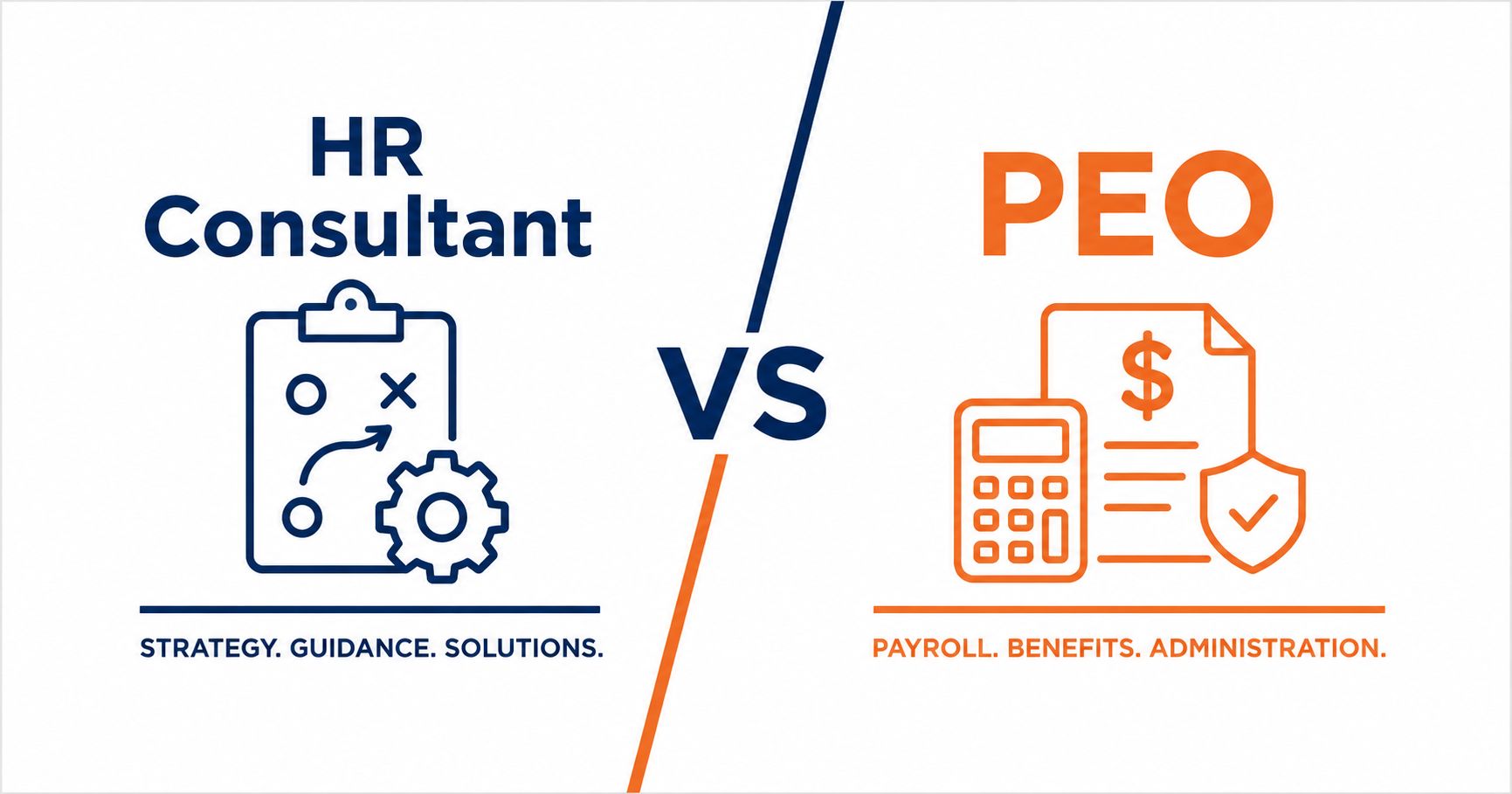
Choosing between an HR consultant and a Professional Employer Organization (PEO) depends on what your business needs most. Some organizations need strategic HR guidance while maintaining control of their employees. Others want administrative support, access to employee benefits, and help managing HR operations.
Neither solution is automatically better. The right choice depends on your company’s size, goals, internal resources, growth plans, and the type of HR support you are looking for.
Quick Answer: HR Consultant vs PEO
An HR consultant provides strategic guidance and HR expertise while you remain the employer of record. A PEO provides administrative HR services through a co-employment relationship that may include payroll administration, benefits administration, workers’ compensation support, and HR resources.
What Is an HR Consultant?
An HR consultant works alongside business leaders to improve how people, managers, and organizations perform.
Rather than simply handling administrative tasks, an experienced HR consultant helps companies solve people challenges, strengthen leadership, improve recruiting, reduce risk, and build systems that support long term growth.
HR consulting services may include:
- Fractional HR leadership
- Employee relations
- Performance management
- Leadership coaching
- Recruiting strategy
- Compliance guidance
- Employee handbooks
- Compensation strategy
- Manager development
- Organizational planning
- Culture development
- Workplace investigations
With HR consulting, your company remains fully responsible for employment decisions while gaining experienced guidance and support.
Learn more about HR Consulting from Turning the Corner HR.
Explore our Fractional HR services.
What Is a PEO?
A Professional Employer Organization (PEO) provides HR administrative services through a co-employment relationship.
Depending on the provider, PEO services may include payroll administration, benefits administration, tax administration, workers’ compensation support, HR technology, and access to HR resources.
Although the PEO becomes a co-employer for certain administrative purposes, your company continues to direct employees, manage performance, make hiring decisions, determine compensation, and oversee day to day operations.
Services offered by individual PEOs vary, so businesses should carefully review each provider’s capabilities before making a decision.
HR Consultant vs PEO: Side by Side Comparison
| Feature | HR Consultant | PEO |
|---|---|---|
| Primary focus | Strategic HR guidance and business support | Administrative HR services |
| Employer of record | Your business | Co-employment relationship |
| Payroll administration | Typically coordinated through payroll partners | Often included |
| Benefits administration | Can coordinate with benefit partners | Often included |
| Leadership coaching | Core service | Varies by provider |
| Recruiting support | Often available | Varies |
| Strategic planning | Strong emphasis | May be limited |
When an HR Consultant Is Usually the Better Choice
You Want Strategic HR Leadership
Many businesses already have payroll, benefits, and HR technology in place. What they need is experienced guidance to help managers lead effectively, improve recruiting, reduce risk, strengthen culture, and support business growth.
You Want to Keep Existing Providers
If you already have payroll, benefits, retirement plans, or HR technology you like, an HR consultant can work alongside those partners rather than replacing them.
You Need Flexible Support
Consulting engagements can grow or shrink as your business changes. Many organizations begin with Fractional HR and expand support as they grow.
Learn more about Fractional HR pricing.
When a PEO May Be the Better Choice
You Want Payroll and Benefits Administration in One Solution
Many businesses choose a PEO because they want one provider to help administer payroll, employee benefits, payroll taxes, workers’ compensation, and related HR administration.
If your primary goal is simplifying HR administration rather than adding strategic HR leadership, a PEO may be a good fit.
You Need Access to Larger Group Benefits
Some PEOs provide access to benefit programs that may be attractive to smaller employers. Available plans and pricing vary by provider, industry, workforce demographics, and location.
Businesses should compare total value, not simply premiums, when evaluating benefit options.
You Prefer Administrative HR to Be Centralized
If leadership wants one organization coordinating payroll administration, benefits administration, HR technology, and certain compliance functions, a PEO may provide the level of administrative support the company is seeking.
Can an HR Consultant Work With a PEO?
Absolutely.
Many growing businesses use both.
A PEO may manage payroll administration, benefits administration, HR technology, and certain administrative responsibilities while an HR consultant focuses on strategy, leadership development, employee relations, recruiting, performance management, workplace investigations, and organizational growth.
The two approaches are not mutually exclusive. In many cases they complement one another.
Common Misconceptions
“A PEO Replaces Leadership”
No. Leadership still hires employees, manages performance, establishes culture, makes compensation decisions, and directs day to day operations.
“An HR Consultant Only Handles Compliance”
Experienced HR consultants often help businesses improve leadership effectiveness, recruiting, employee engagement, retention, succession planning, organizational structure, workplace culture, and long term people strategy.
“Choosing One Means I Cannot Use the Other”
Many businesses successfully combine strategic HR consulting with a PEO relationship to receive both administrative efficiency and experienced business guidance.
Cost Considerations
Comparing an HR consultant and a PEO solely on price can be misleading because they often solve different business challenges.
When evaluating options, consider:
- Your current payroll provider
- Your employee benefits strategy
- Internal HR expertise
- Recruiting needs
- Leadership development goals
- Employee relations complexity
- Compliance risk
- Expected company growth
The lowest cost solution is not always the best long term investment. The right solution is the one that addresses your organization’s most important needs.
Compare Fractional HR with hiring an internal HR manager.
Frequently Asked Questions
What is the biggest difference between an HR consultant and a PEO?
An HR consultant primarily provides strategic HR expertise and guidance while your company remains fully responsible for employment administration. A PEO typically provides administrative HR services through a co-employment relationship.
Does Turning the Corner HR operate as a PEO?
No. Turning the Corner HR is an HR consulting firm. We provide Fractional HR, HR consulting, recruiting, leadership development, compliance support, and strategic people guidance. We do not operate as a Professional Employer Organization.
Can an HR consultant work with my payroll company?
Yes. Turning the Corner HR regularly works alongside payroll providers, benefits brokers, employment attorneys, insurance professionals, and other trusted partners.
Can I leave a PEO and hire an HR consultant?
Yes. Some organizations eventually move away from a PEO as their business grows or their HR needs change. Others continue using a PEO while adding strategic HR consulting support.
Which option is better for a growing business?
The answer depends on your priorities. If your primary need is strategic HR leadership, recruiting, leadership coaching, employee relations, and organizational development, an HR consultant may be the better fit. If your priority is consolidating payroll, benefits, and HR administration, a PEO may be appropriate.
Can an HR consultant help with recruiting?
Yes. Many HR consulting firms, including Turning the Corner HR, provide recruiting strategy and direct recruiting services.
Learn more about our recruiting services.
Does an HR consultant replace my attorney?
No. HR consultants provide practical HR guidance but do not provide legal advice. When legal counsel is needed, Turning the Corner HR works collaboratively with employment attorneys and other trusted advisors.
Can an HR consultant help develop managers?
Yes. Leadership coaching, manager development, performance conversations, employee relations, and workplace culture are common areas where experienced HR consultants provide significant value.
Why Businesses Choose Turning the Corner HR
Turning the Corner HR partners with growing organizations across the United States to provide practical, strategic HR guidance that supports long term business success.
Our team works alongside leadership to strengthen recruiting, improve manager effectiveness, reduce compliance risk, build healthier workplace cultures, and create HR strategies aligned with business goals.
We do not administer payroll or employee benefits. Instead, we collaborate with trusted payroll providers, benefits brokers, employment attorneys, insurance professionals, and other specialists so clients receive the expertise they need while maintaining the flexibility to choose the partners that best fit their business.
See how we’ve helped our clients grow.
Continue Reading
- Fractional HR Services
- Fractional HR vs Hiring an HR Manager
- What Does Fractional HR Cost?
- HR Outsourcing vs Fractional HR
- When Should a Small Business Hire HR?
Which HR Solution Fits Your Business?
Every organization is different. Some businesses benefit from the administrative support of a PEO. Others need strategic HR leadership while keeping their existing payroll, benefits, and technology providers. Many organizations successfully combine both approaches.
If you’re unsure which option best supports your growth, schedule a free HR consultation. We’ll help you evaluate your current HR needs and recommend an approach that aligns with your business goals.