
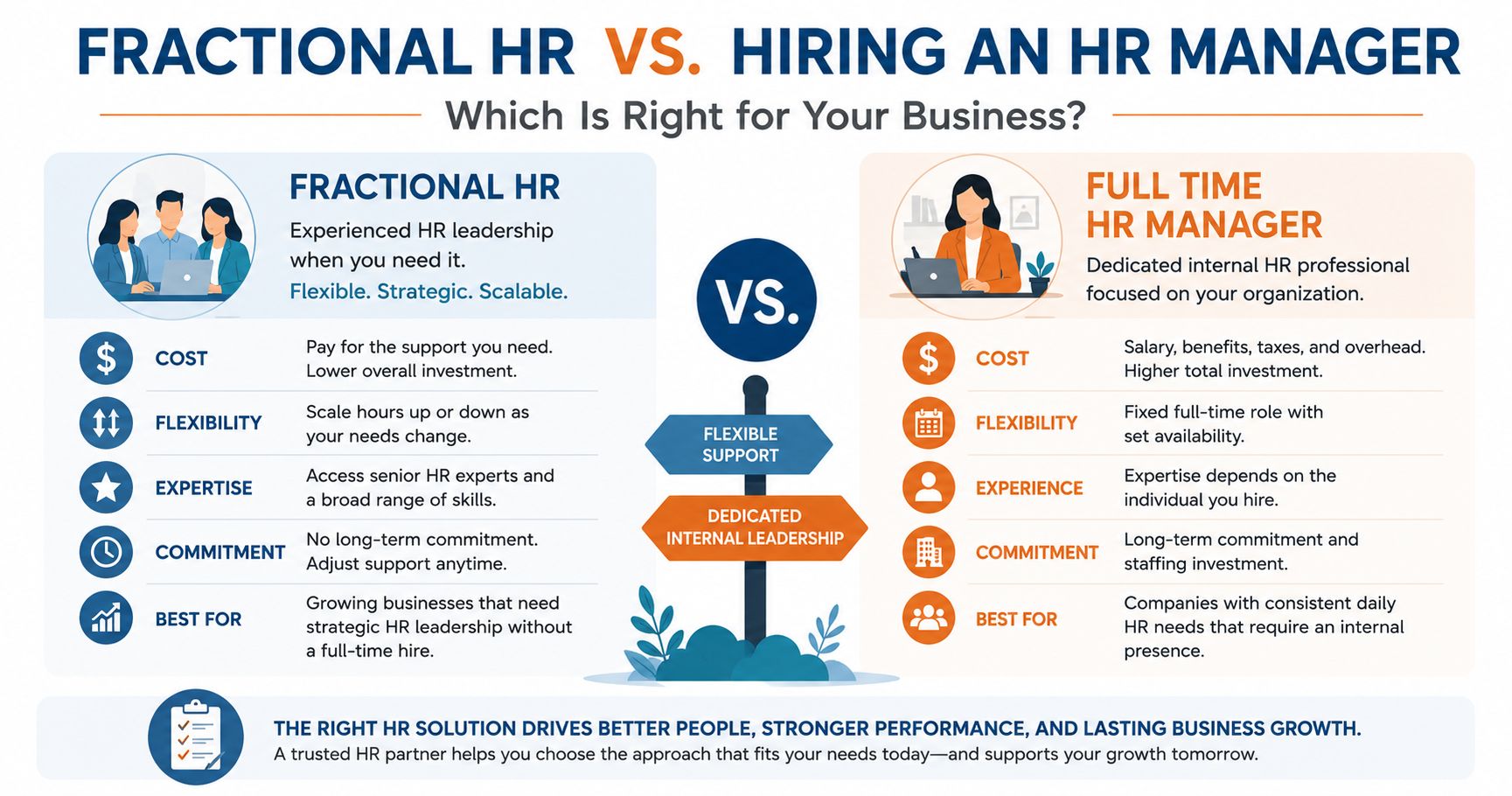
Fractional HR is often the better choice for a growing business that needs experienced HR leadership but is not ready to hire a full time HR manager. A full time HR manager may be the right choice when the company has enough daily HR work to support an internal role and needs someone available or embedded in the business every day.
The best decision depends on your company’s size, growth rate, HR workload, budget, compliance needs, and the level of experience required. The goal is not simply to choose the least expensive option. It is to choose the HR model that gives your business the right support at the right time.
Quick Answer: Fractional HR vs Hiring an HR Manager
Choose Fractional HR when you need flexible, experienced HR leadership without the cost or commitment of a full time employee. Hire an internal HR manager when your business has enough consistent HR work to require daily support from someone fully dedicated to the organization.
What Is Fractional HR?
Fractional HR gives a business access to experienced HR professionals for a portion of the time and cost associated with a full time hire.
A Fractional HR partner may work with the company for a set number of hours each week, provide ongoing monthly support, lead specific projects, or serve as an extension of the leadership team.
Fractional HR support can include:
- Strategic HR planning
- Employment compliance
- Employee relations
- Manager coaching
- Performance management
- Policies and employee handbooks
- Compensation planning
- Recruiting and onboarding
- Leadership development
- Workplace culture
- Organizational planning
The company receives experienced HR guidance without hiring a full time employee before the workload or budget supports one.
Learn more about Fractional HR services from Turning the Corner HR.
See what affects Fractional HR pricing and what services may be included.
What Does an Internal HR Manager Do?
An internal HR manager is a full time employee responsible for managing the company’s day to day HR needs.
Depending on the organization, the HR manager may handle recruiting, onboarding, employee relations, benefits coordination, compliance, performance management, policies, training, and workplace investigations.
An internal HR manager can become deeply familiar with the company’s people, culture, systems, and daily operations. This can be valuable when the organization has enough ongoing HR work to support a full time position.
The challenge is that one HR manager may not have deep experience in every area the business needs. A strong generalist may still need outside support for complex compliance matters, executive recruiting, compensation strategy, investigations, leadership development, or specialized training.
Fractional HR vs Hiring an HR Manager: Key Differences
| Factor | Fractional HR | Full Time HR Manager |
|---|---|---|
| Cost structure | Pay for the level and amount of support needed | Salary, benefits, payroll taxes, equipment, and overhead |
| Flexibility | Support can expand or decrease as needs change | Fixed full time role |
| Experience | Access to senior HR expertise and often a broader team | Experience depends on the individual hired |
| Daily availability | Available according to the service agreement and business needs | Dedicated to the company during working hours |
| Scalability | Can adjust as the company grows or changes | May require additional hires as workload increases |
| Hiring risk | Lower commitment than adding a full time employee | Requires recruiting, onboarding, retention, and management |
| Best fit | Growing companies that need experienced support without a full time role | Companies with steady daily HR demands that require an internal presence |
When Fractional HR Is Usually the Better Choice
1. Your Business Needs Senior HR Expertise but Not Full Time Coverage
A growing company may need help with compliance, performance management, leadership, recruiting, and workplace culture, but not have enough daily work to justify a full time position.
Fractional HR allows the company to access experienced leadership at the level it needs today.
2. You Need a Broader Range of HR Skills
One internal HR manager cannot be an expert in every area of human resources.
A Fractional HR firm may provide access to professionals with different strengths, including employee relations, compliance, recruiting, compensation, leadership development, and organizational strategy.
This can be especially valuable when the business needs both strategic guidance and practical implementation.
3. Your HR Needs Change Throughout the Year
Some periods require more HR support than others. A company may need intensive help during rapid growth, a leadership transition, a compliance review, a recruiting push, or a workplace investigation.
Fractional HR can expand during those periods and decrease when the workload becomes lighter.
4. You Want to Build HR Systems Before Hiring Internally
A Fractional HR partner can help establish the foundation an internal HR employee will eventually inherit.
This may include:
- Policies and procedures
- Employee files and documentation
- Onboarding processes
- Performance management systems
- Manager expectations
- Compliance practices
- Job descriptions
- Recruiting workflows
Building the foundation first can make a future internal HR hire more effective.
5. You Need an Objective Outside Perspective
An experienced outside HR partner can identify patterns and risks that may be difficult to see from inside the organization.
This perspective can help leaders make clearer decisions about structure, performance, culture, compensation, and employee relations.
6. You Want to Reduce the Risk of Hiring the Wrong HR Person
Hiring the wrong HR manager can create serious problems. The person may lack the necessary experience, struggle to gain leadership trust, or be placed in a role that is too broad for one individual.
Fractional HR gives the business time to understand its needs before committing to a full time position.
Learn when a growing business should bring in professional HR support.
When Hiring a Full Time HR Manager May Make More Sense
1. You Have Enough Daily HR Work for a Full Time Role
If employee questions, recruiting, onboarding, benefits coordination, performance management, documentation, and employee relations require consistent daily attention, a full time HR manager may be appropriate.
2. You Need Someone Physically Present Every Day
Some businesses benefit from an HR leader who is regularly on site, especially when the workforce is concentrated in one location or daily employee interaction is important.
3. HR Is Highly Integrated Into Daily Operations
Companies with complex schedules, large hourly workforces, multiple shifts, frequent hiring, or extensive administrative responsibilities may need an internal HR professional closely connected to daily operations.
4. The Company Is Ready to Build an Internal HR Department
A full time HR manager may be the right first step when the organization expects HR responsibilities to continue growing and plans to add specialists or coordinators later.
5. Leadership Wants a Dedicated Internal Partner
Some leadership teams prefer to have an HR manager fully embedded in the organization and available for daily conversations, meetings, and decisions.
The Cost of Fractional HR vs a Full Time HR Manager
The cost comparison should include more than salary.
A full time HR manager may involve:
- Salary
- Payroll taxes
- Health insurance
- Retirement benefits
- Paid time off
- Bonuses
- Recruiting costs
- Technology and equipment
- Training and professional development
- Management time
Fractional HR is typically structured around a defined level of monthly support, project scope, or number of hours. The business pays for the services it needs without adding the full cost of another employee.
Fractional HR engagements at Turning the Corner HR typically start at $1,500 per month, depending on scope and complexity.
Price should not be the only consideration. The value also depends on the quality of advice, the experience of the HR professional, the speed of implementation, and the risks the company avoids.
Read the complete guide to Fractional HR pricing.
Common Mistakes Businesses Make When Choosing HR Support
Waiting Until There Is a Crisis
Many companies seek HR support only after a complaint, termination, compliance concern, or serious employee conflict.
Bringing in HR earlier gives the business time to build better systems and prevent avoidable problems.
Hiring a Junior HR Employee for a Senior Role
A less experienced employee may be capable of handling administrative tasks but may not be prepared to advise executives, manage complex employee relations, or build HR strategy.
The job title should match the actual level of responsibility and expertise required.
Assuming One HR Person Can Do Everything
HR includes many specialties. Recruiting, compliance, compensation, employee relations, leadership development, benefits coordination, and workplace investigations require different skills.
Leaders should be realistic about what one person can manage effectively.
Choosing Only by Price
The lowest priced option may not provide the experience, responsiveness, or strategic support the company needs.
A poor HR decision can create costs through turnover, bad hiring, legal risk, inconsistent management, and lost productivity.
Failing to Define Expectations
Before choosing Fractional HR or hiring an HR manager, clarify what success should look like.
Identify the company’s most important needs, expected responsibilities, required experience, availability, reporting relationship, and business goals.
Can Fractional HR and an Internal HR Manager Work Together?
Yes. The choice is not always one or the other.
A Fractional HR partner can support an internal HR manager by providing additional expertise, strategic guidance, project leadership, or temporary capacity.
For example, an internal HR manager may handle daily employee support while a Fractional HR partner assists with:
- Executive recruiting
- Compensation strategy
- Workplace investigations
- Leadership development
- Compliance reviews
- Organizational planning
- HR technology implementation
- Succession planning
This combination can give the company both internal continuity and access to broader expertise.
How a Trusted HR Partner Helps You Choose
A trusted HR partner should help you evaluate what the business actually needs rather than automatically selling one solution.
The right partner will consider:
- Current employee count
- Expected growth
- Management structure
- Compliance complexity
- Recruiting volume
- Employee relations needs
- Available budget
- Leadership expectations
- Existing internal HR capabilities
The recommendation may be Fractional HR, a full time HR manager, a combination of both, or a phased approach that changes as the company grows.
Explore strategic HR consulting services from Turning the Corner HR.
Frequently Asked Questions
What is the main difference between Fractional HR and an HR manager?
Fractional HR provides flexible access to experienced HR support without adding a full time employee. An HR manager is a dedicated internal employee responsible for the company’s ongoing HR needs.
Is Fractional HR only for small businesses?
No. Fractional HR can support small and mid sized businesses, rapidly growing organizations, companies with internal HR teams, and larger employers that need specialized expertise or additional capacity.
Can Fractional HR handle employee relations?
Yes. Fractional HR can support performance concerns, manager coaching, employee complaints, documentation, workplace investigations, and difficult employment decisions.
Can Fractional HR help with recruiting?
Yes. Support may include job descriptions, recruiting strategy, candidate sourcing, interview structure, selection, offer development, and onboarding.
Learn more about Turning the Corner HR recruiting services.
When should a company hire its first full time HR manager?
A company should consider a full time HR manager when there is enough consistent daily HR work to justify the role, leadership needs an embedded internal partner, and the budget can support the full cost of the position.
Can a Fractional HR partner help hire an internal HR manager?
Yes. A Fractional HR partner can help define the role, determine the appropriate level of experience, recruit candidates, structure interviews, evaluate finalists, and transition responsibilities to the new employee.
How much does Fractional HR cost?
Fractional HR engagements at Turning the Corner HR typically start at $1,500 per month. The final investment depends on scope, complexity, employee count, and the level of support required.
Is Fractional HR the same as HR outsourcing?
Fractional HR is a type of HR outsourcing, but not all outsourced HR is Fractional HR. Fractional HR generally provides a more integrated and strategic relationship with ongoing leadership support.
Compare HR outsourcing with Fractional HR.
How can I evaluate what kind of HR support my business needs?
Start by reviewing the amount of time leaders spend on employee issues, the complexity of your compliance needs, the consistency of your management practices, your recruiting volume, and your expected growth.
You can also take the free People Strategy Assessment to identify strengths and gaps in your current people practices.
Why Businesses Trust Turning the Corner HR
Turning the Corner HR serves growing organizations across the United States as a trusted HR partner. Since 2011, our experienced team has helped business owners, executives, and managers strengthen leadership, improve recruiting, reduce HR risk, manage employee relations, and build sustainable people practices.
Our services include Fractional HR, strategic HR consulting, recruiting, compliance and risk management, leadership development, training, and workplace culture support.
Turning the Corner HR does not process payroll or administer employee benefits. When clients need payroll, benefits, employment law, insurance, technology, or another specialized service, we can recommend trusted partners and collaborate with those providers.
Explore our Client Success Stories to see how we have supported other organizations.
Continue Reading
- Fractional HR Services for Growing Businesses
- When Should a Small Business Hire HR?
- What Does Fractional HR Cost?
- HR Outsourcing vs Fractional HR
- 7 Signs You Have Outgrown DIY HR
- Why Growing Companies Choose Fractional HR
Which HR Model Is Right for Your Business?
Fractional HR and a full time HR manager can both be effective. The right choice depends on how much support your company needs, the level of expertise required, and where the organization is in its growth.
Every business reaches this decision at a different stage. The right solution should reflect your goals, current challenges, growth plans, and existing internal resources.
Take the free People Strategy Assessment to evaluate your current HR needs, or schedule a free HR consultation with Turning the Corner HR to discuss the best approach for your business.