
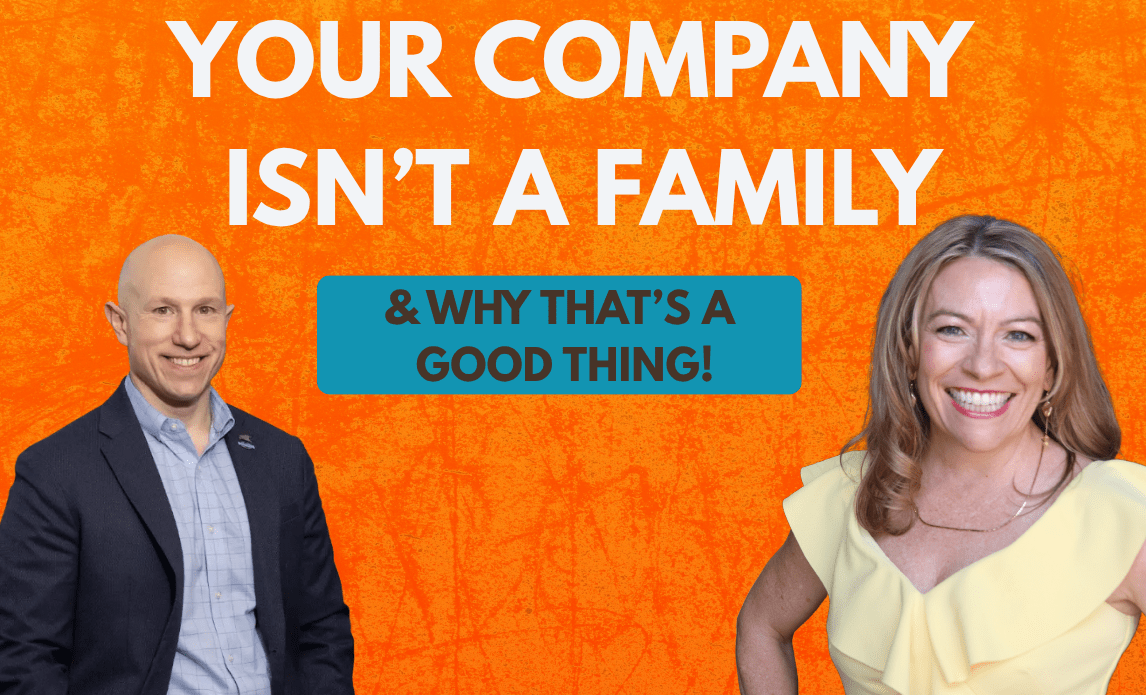
What creates a truly high-performing organization? According to Scott Lewis, it isn’t more policies, tighter controls, or bigger perks—it’s building a culture where people are trusted, recognized, and empowered to do their best work.
In this episode of How I Turned the Corner, Kendra sits down with Scott Lewis, Co-Founder and CEO of Spartan Investment Group, to discuss the leadership principles that have helped grow the company to more than $800 million in assets under management while maintaining a people-first culture.
Scott shares why he believes leaders should focus on principles over policies, why companies should think of themselves as teams rather than families, and how meaningful recognition can transform employee engagement and performance. He also reflects on lessons from his military background, the importance of accountability without micromanagement, and how AI is changing the future of work.
Whether you’re an entrepreneur, executive, manager, or someone looking to become a better leader, this conversation offers practical insights you can apply to build stronger teams, healthier workplace cultures, and more resilient organizations.
In this episode, you’ll discover:
- Why trust is more powerful than bureaucracy
- How recognition drives engagement and performance
- The difference between managing assets and leading people
- Why Scott believes companies are teams—not families
- Leadership lessons from the military that translate to business
- How AI can enhance productivity while keeping people at the center of the organization
View Transcript
Transcript — How I Turned the Corner, hosted by Kendra Prospero
Kendra: My guest today has 800 million in assets under management, and he does that with about 42,000 storage units across the country and other means. But ask him what keeps him up at night, and I’ll bet it’s not the real estate — it’s the people. Scott Lewis is the co-founder of Spartan Investment Group, a leader who knows you can’t just invest your way to success without the right team. Scott, welcome to How I Turned the Corner.
Scott: Thank you, Kendra. Appreciate being here.
Kendra: So when we were chatting before this started, we talked a little about the fact that your industry isn’t necessarily known for stepping up and taking care of its people first, and yet you’ve taken that approach and it’s led to a lot of success. I’d love to hear the origin story — why did you make this a focus from the beginning?
Scott: Yeah, it’s interesting. I wouldn’t describe myself as an entrepreneur — I mean, obviously by definition I am, right — but I didn’t have popsicle stands or do any of that stuff when I was younger. My partner Ryan did, he sold Cutco knives and all that, but I never really saw myself being the CEO of a company or a business owner. One of the main reasons I did this is people-related. I tell a story about a company I worked for early in my career — there was a team member there, a really good team member, and the job was this combination of very scientific, technical skills with a personality to interact with the customer. Pretty difficult combo to find. The company was very traditional, 8 to 5, and this guy just could not get to work at 8:00. I don’t know what it was about 8:00, but he’d be there at 8:05, 8:15, whatever. And they gave him so much grief. It didn’t matter what time he showed up — 9:00 or 7:00, it was irrelevant to the actual execution of the business. And I always thought, what are you doing? You have somebody here who’s dedicated to the company, which is a very rare skill to find, who works hard, and you’re giving him grief because he was five minutes late. I get it — I’m a military guy, so standards and being on time, I 100% understand that. And he wasn’t adhering to the standard, but why is the standard there? That was one of the main reasons I decided to go out on my own — there was just so much stupid stuff. I was working for the federal government at the time, and if you want to talk about stupid HR stuff, you could fill 700 episodes on the stupidity of HR practices in the federal government.
Kendra: Right.
Scott: I like to say rules are a substitute for intelligence. That’s it — I was like, this is stupid, what are we doing? So that was a key thing in creating an environment that was better for people who were motivated, who had initiative. I’m a big fan of McGregor’s Theory X versus Theory Y — X being industrial, “butts in seats,” Y being motivated and trusting your people, for a shorter version of it. I’m very much a Theory Y guy. We don’t have a leave program here, we don’t track hours — it’s do your job and be part of the team, and if you’re not on the team, go. That was one of my founding beliefs: if you get the right people on the team, you can do a lot with not a ton of folks. As I mentioned, I’m an Army guy, and my ideology comes from the special operations world, where there’s a very small group of operators who can do very big things because they’re highly trained, highly motivated, and they really want to be there. That was our ideology from the start — and you can’t do that unless you have a mission-focused, people-first mentality.
Kendra: Very true, that’s such a great story and I absolutely agree with you. We had a client a few years ago who wanted me to go in and fire one of his employees because she was late every day, in the same kind of environment — there’s no reason it mattered, they’re not making money by being in person. There was really no reason for the rule other than it was a standard. So I dug in with him, and he said, “well, it’s a sign of respect.” So I said, let me go talk to her. It turned out her kid’s school drop-off was at 8, and she wasn’t going to drop her six-year-old off at 7:45 and leave him to fend for himself for 15 minutes. She was getting there as soon as she could. So when I told him this story, I said, what if we just adjusted it to “be here between 8 and 8:30”? And sure enough, she was still there every day at 8:15 — exceeding expectations. But it was this ridiculous thing where we just don’t think about what people need, and really ask them the question. So can I ask you — with your military background, and standards being such a huge part of who you are — what are the guardrails and standards that are uncompromisable for you at Spartan?
Scott: I think our values — growth, respect, integrity, tenacity, and transparency — those are immutable. They’re not just on the wall behind me [laughs], it’s really a life philosophy here. I think when you look at the military, even the most rigid organization on the planet, there’s definitely flexibility as to when you do things and when you don’t — some of that’s scale. If you’re a 500,000-person company, or the military, the things you can do are very different than when you’re smaller. So for us, I think we have principles instead of policies. Our principles are immutable, but they give some flexibility based on operational or personal constraints. For instance, if our facilities have to be open at 9:00, and a manager shows up every day at 9:05 because her child has to be dropped off, that may be the wrong position for her — we can’t change that standard. But in your example, if you’re at headquarters, what’s the difference if you start at 8:30 or 8:00? Sometimes there are operational reasons — our construction company has a standup meeting at 8:00 every day, and everybody’s required to be there because that’s when the site supers get things started, and there’s an operational reason for it. So that’s where we hold the standards — if there’s an operational reason for it, you can’t violate it, and if it doesn’t work for you, that’s okay, we’ll either get you into a different position or a different company. We can’t move that standard. But for the vast majority of headquarters folks in any company, the standard should be the ones that drive revenue. Otherwise, if there’s flexibility available, it should be afforded unless there’s a reason not to.
Kendra: Yeah, I think so too, and I think that clarity you’re able to provide your staff — helping them understand why it’s important, why you have to be here at 8 a.m. because that’s when we’re coming together to figure out the plan for the day — that clarity is why people are willing to do it. It’s the arbitrary rules that don’t make sense, like your example. We like to call this, in our world, giving people agency — helping them have agency over where they work, when they work, and how they work, within boundaries — really having people understand why they need to be there, and then giving them flexibility within those other boundaries. It sounds like that’s exactly what you’re doing.
Scott: Yeah, a key text I’m big on — I read a lot of books — a key text that ties into what you’re saying is Dan Pink’s Drive.
Kendra: Yeah.
Scott: Very much on autonomy, purpose, and mastery — very similar to what you just got at. That’s been a fundamental foundation to our entire team-development philosophy at Spartan — don’t make me manage you. If I have to manage you, you’re probably going to work somewhere else, because you lead people, you manage assets, and we want to keep our team lean. Going back to the private equity world, we want to keep our team as lean as we can, and you do that by staffing people who have a sense of purpose for your mission. There can be lots of different purposes — it’s almost impossible to tie it all into one. If you have a mission like SpaceX, or the Red Cross, those are a little easier to find, but those are pretty rare — the vast majority of companies don’t have missions that drive real purpose in somebody. It’s very hard to have real purpose in self-storage. We’re selling dry air, let’s be real. [laughs] But the way we create purpose is, right now we’re backed by retail networks of investors — those are individual people, so our team can come to work knowing they’re helping out friends, cousins, that kind of thing. Some of that’s great, but some of it’s internal — some people have their own purpose. But that whole philosophy of purpose, mastery, and autonomy — no set hours, no leave tracking, do what you need to do, get your job done — that’s the foundation for our entire team philosophy.
Kendra: Well, I think you make a really important point I’d like to call out to the listeners: you don’t have to have an altruistic mission to still have purpose for your employees. We have a very altruistic mission — my “why” for my company is to end suffering in the workplace, which is pretty altruistic, and people can get behind that pretty easily. But let’s be real, like you said, you’re selling dry air — you’re going to have to make a bigger connection to people. I think the way you called that out is so appealing, because there are also people out there who want to make money, who have a background in financial management or property management, and you just bridged that connection for your employees. And for the listeners, I want to recognize too — in your companies, every job should have meaning of some sort, there’s some reason that job exists, and sometimes you just have to connect the dots, like Scott just did. That’s the part I think is often missing — why does it have meaning?
Scott: So that’s great, I love that.
Kendra: So coming back to the origin story — here you are, all these years later. Tell us a little about what you do now — some of the really unique things you do for recognition. Do you want to share some of the recent things you’ve brought into your company to continue this amazing culture?
Scott: One thing I’ll start with is most companies probably under-recognize by a factor of 10, and I think it’s because people feel like recognition has to be big things — I’ll talk about some big things, but I’ll also talk about some small things. A lot of leaders get hung up because they feel like recognition has to be huge, and it really doesn’t — it’s actually very easy to do. Some of the bigger things we do — Kendra just mentioned, we did a big thing for our property managers. We own and operate self-storage facilities, about 90 assets across the United States, with about 80 field team members. We take the top 10% — we call it the Elite Circle, which is a terrible name, but that’s what happens when you give your team the autonomy to name it themselves; sometimes they come up with things that sound terrible that they like. And here we are with the Elite Circle — our top 10% of the field team, and we take them to Cabo for a couple of days to really recognize them for their hard work, based on a number of metrics. This is our first year doing it — one of our investors does this for his company, a much bigger company than ours, and he told us it’s one of the key things that’s really driven results for him. So I literally got back yesterday, and it was such an honor to take five people out of the country — this was two of their first time ever outside the United States, and their first time on an airplane. Some really good stuff came out of that, and it’s not going to break the bank because we did it smartly, all-inclusive. We also have what’s called carried interest — a private equity term for the ownership we have in our deals — and we carve off a certain percentage and create pools every year for every single employee, even down to our property managers, to recognize them for their work.
So those are some of the bigger things. But I’m a military guy, so — a challenge coin, I’ll save the podcast time explaining it, but there’s a tradition in the military called a challenge coin that represents certain things, and we do that for our team members. We do birthdays. We do a lot of the same stuff a lot of people should be doing, and I don’t think anything we’re doing is overly special — I just think we’re pretty consistent about keeping it at the forefront and reminding our leaders about recognition, about the things we can do. And a handwritten note is about the best thing a leader can do, and it’s free — it doesn’t cost you anything and it goes a long way. If you’re a leader and you’re not writing 10 notes a week, you’re probably not doing it right.
Kendra: That’s great. It’s amazing to me that those two words, “thank you,” have become some kind of hoarded thing — where people don’t feel like they should have to thank someone for doing their job.
Scott: Yeah, why not? It’s two words. [laughs] You can go so far.
Kendra: Yeah. So what other things are you doing? You’ve got the handwritten notes, the coins — give us some more insight into what else you’re doing.
Scott: So one of the things I do is, every single week I have a calendar of all my team members’ birthdays, and I give them a handwritten note and a scratch-off lottery ticket.
Kendra: Oh!
Scott: We send them all over the place — they’re like a buck. One of our property managers won $500 on one. [laughs] To a property manager, $500 is really meaningful, and it costs a buck. I also write notes — once a month I send out a happy birthday card and a $5 Barnes & Noble gift card to every single team member’s spouse and children, through the entire corporation. A couple hundred bucks a month, nothing big.
Kendra: That’s huge.
Scott: We have an internal system — there’s a lot of digital ways to do it, Slack has some stuff — we have an internal system (heard as “Leapum” — likely a different platform name; please verify the exact tool name before publishing), our overall goal-management system, which also has a digital praise side. That thing is pinging almost all day, and everybody has access to it. And the last thing I’ll leave you with is a weekly sync every Monday, where we go around the room with everybody on the sync — sometimes 30 or 40 people — and everyone says one thing they’re grateful for from somebody else inside the company. We’ve done that every single Monday for 10 years. So that’s some high-level recognition, and some free stuff.
Kendra: Has any of that ever felt cringeworthy to you?
Scott: No, I don’t think so. I think people really like the sync — the gratitude piece is one of the things we hear new team members say is one of the coolest things we’ve ever done. That’s something we hear on a fairly consistent basis from our team.
Kendra: Yeah, we do that too — at the beginning of our team meeting every week we do what we call “shoutouts,” and it’s lovely, such a great chance for the team to recognize each other, because as a leader you don’t always have enough visibility into what everyone is doing to physically thank everyone yourself — you just don’t know. But when you hear what everyone else says about each other, it feels just as good to the team members, because they’re being recognized by their teammates. So yeah, that’s fantastic. I think a lot of leaders get tripped up trying to be creative about this, and you don’t have to read some leadership book and do exactly what it says — there’s nothing creative that needs to come from recognition. Just do something.
Scott: Yeah, exactly. People actually have a really high tolerance for mediocre management. But a bad manager, a terrible manager — no, not a lot of tolerance for that. That’s what makes people leave. So yeah, you’re right — just doing something is better than coming up with some totally brilliant program that’s going to win awards. [laughs] If there were such a thing, such an award category.
Kendra: [laughs] Well, so now tell us about some of the people on your team — we’d love to help attract more people into your organization with this podcast. Some of our former interviewees have clipped parts of the podcast and used it on their about-us page — and by the way, for the listeners, in the show notes there’s Scott’s website with a great about-us page and careers page. But what kind of people are you looking for?
Scott: I’d say initiative is a big deal here — it’s hard to teach. I’ve found that it’s an attribute that’s very hard to teach; if somebody doesn’t have initiative, you really can’t fix that. So to be successful here at Spartan, you’ve got to have initiative — if somebody’s constantly asking what to do and not looking around the corner, probably not going to last very long. I’d say that’s the number one thing. And then integrity — everybody has a different definition of that, but as a real estate private equity company with investor money on the line, being able to admit mistakes and learn from them is huge, and that’s a big deal here. One of our sync meetings every week talks about lessons learned — really about talking about mistakes and what you learn from them. Initiative and integrity are probably the two most important attributes at our company.
Kendra: Okay, that’s great. And you’ve got the property management people — so you’ve got different divisions or groupings of employees. You’ve got property managers who are all over, and then your headquarters location, which is more the financial side. Is that correct?
Scott: Yep. We have an office in Golden, an office in Seattle, and we’re spread out all over with our facilities. We also have a Manila-based team in the Philippines, one team member in Mexico, and a construction company also here in Golden. Then we have our site superintendents who move around the country as our projects move. So it’s actually kind of a difficult recruiting perspective because we have all these different levels — sometimes in the same building — so it can get interesting.
Kendra: Yeah. How do you manage the field-team culture versus the headquarters culture? What tricks do you have around that, because that’s always a challenge when you have an office setting and then a separate setting, like a warehouse, manufacturing line, or field team. What are some of the tricks you have for managing and keeping the cultures feeling similar?
Scott: I think we have different brands, but if you asked any team member, they’d tell you they’re a Spartan. There’s a couple different ways we do that — our values are uniform across all the companies, but SCM and FreeUp each have a second set of values, more like guiding principles. SCOPE is SCM’s mnemonic and SPACE is FreeUp’s, but everybody’s a Spartan. Everybody goes through very similar onboarding, with about a 20% variation depending on which company you’re working inside of — FreeUp, SIG, or SCM. We standardize the onboarding, so everybody reads the same values, the same mission, the same vision for the parent company. A lot of our benefits are very similar, with some field-based differentiation — you can’t offer “unlimited PTO” to a property, that doesn’t work. We have a creative benefit called “two weeks work from anywhere” that works well from a headquarters perspective, but doesn’t really work in the field, so we’ve adjusted the benefits package. But it’s really one team, one fight — we’ve standardized our values across the entire organization, and we tie all performance reviews, no matter what role, back to our values. We do 360s — the field team has a slightly different one, more of a nine-block — but everything ties back to our values to keep it as uniform as possible. You’ll always get variations — even in the military, the culture in the 82nd Airborne is very different from the culture in the (heard as “first cab division” — likely the 1st Cavalry Division; please verify before publishing), but it all ties back to the overarching Army principles, even though the ideologies and how some units do things can be very different depending on where you are.
Kendra: That’s fantastic. So you also don’t call your people employees, you call them teammates — but definitely not a family, right? Tell us more about that — why the differentiation? Some people love to call their organization a family, which is a big eye-roller for me personally.
Scott: [laughs] I agree — one, it’s an eye-roller because we’re not a family. No, we’re not. Family is allowing cousin Eddie to park his RV in your driveway for a month during Christmas.
Kendra: Right.
Scott: That’s what you deal with with family. I am not going to tolerate the metaphorical cousin Eddie parking his RV in my parking lot for a month.
Kendra: Not going to see it.
Scott: Right. So I think, number one, the whole “this is a family” company thing is nonsense anyway, because when push comes to shove, it’s not a family, it’s a team. And the difference is a team knows the object is to win — that’s what the team is put together to do. Honestly, that’s what companies are put together to do too — win at whatever they’re trying to do. Most of the time that’s profitability, that’s shareholder returns, whatever that is, the company needs to win. I think we’ve gotten away from that a little and forgotten the reason for a company is to win — that’s the team. When you have that team mentality, you have to make the team every single day, or you might end up getting cut. That sounds harsh, but that is the absolute reality of a team versus a family. That’s kind of what we mean by that here. And people have been told, listen, you don’t have to be a jerk about offboarding a team member who isn’t cutting it — you can always be compassionate about that — but it’s not fair to the rest of the team to keep cousin Eddie parked in the driveway when everybody else is doing what they’re supposed to be doing.
Kendra: That is amazing, that’s so important. So many leaders keep people on the team because they care for them, and they see themselves as a steward for one instead of a steward for many, and I think that’s a really good perspective to bring into this.
Scott: Yep.
Kendra: Well, on our final note then — I’d love to hear what’s in the future for you. What’s on your strategic plan when it comes to continuing to support your people? What are the things you and your people team — not HR, but people team — are doing together?
Scott: I think it’s really about a key aspect we’re doing now — in the age of AI, I think it’s been kind of a travesty how it was positioned at first versus what it’s actually turning out to be. One of the things we’re trying to do is hold our team kind of constant and increase our output through tools, training, and skills for our team members in this new era. That’s been a big deal here — we’re really trying to lean forward and leverage those tools so each individual person can grow more, because for us, on the profit share, it’s a limited pie based on what we’re able to acquire in a particular year. So the fewer pieces we have to slice off, and the bigger the pie, the more people get. Going back to that initial ideology around that small, highly-trained, special-forces-type team — that’s what we’re trying to create here, giving people as many tools as possible so we’re really slowing down on hiring and ratcheting up productivity for our team members, so we can grow the pie and each individual team member’s piece is much bigger — so they can achieve the goals and dreams they’re trying to achieve on their personal side.
Kendra: All right, that’s fantastic. Well, I think on that note, that’s a great place to end, Scott. Thank you so much for sharing some of your insight — I think we could have gone on and on for a lot longer, given the amazing work you’ve done with Spartan Investments. Thank you so much for joining me today on How I Turned the Corner.
Scott: Thank you, Kendra. I appreciate it, and hopefully I added value for your listeners.